


State-Specific Compliance
Closegap complies with all applicable federal and state laws regarding student data privacy.
Our practices are designed to ensure student information is collected, used, and protected solely for educational purposes under district direction.
Closegap is available across all 50 US States!
Find more information about privacy and funding in your state:Closegap is also available in Washington, D.C. and is used in 30+ countries around the world!
This guide is informational. It is not legal, financial, or grant compliance advice.
California State Compliance (SOPIPA)
Closegap complies with California’s Student Online Personal Information Protection Act (SOPIPA, Cal. Bus. & Prof. Code §22584), which governs operators of online services used for K–12 school purposes.
Key Protections Under SOPIPA
No Targeted Advertising
Closegap does not engage in targeted advertising to students or their families, whether on our platform or elsewhere, based on student information.No Sale or Commercial Use
Student information is never sold, disclosed, or used for marketing or commercial profiling.No Unauthorized Disclosure
We only disclose information to support educational purposes as directed by schools/districts, to comply with law or legal processes, to protect safety/security, or to service providers under contract who are bound to the same restrictions and safeguards.No Profiling Beyond Educational Use
Closegap’s student profiles are only created to support school purposes, period. Student data is not used for non-educational profiling.Security Standards
Closegap implements and maintains reasonable security procedures and practices appropriate to the sensitivity of covered information, protecting against unauthorized access, destruction, use, modification, or disclosure.Data Deletion
At the request of a school or district, Closegap will delete student covered information under its control. We automatically delete student information after 12 months of inactivity.Permissible Uses
Student data may be used in deidentified or aggregated form to maintain and improve our educational services, to demonstrate product effectiveness, and/or to support research or school-authorized educational purposes.
Funding Alignment
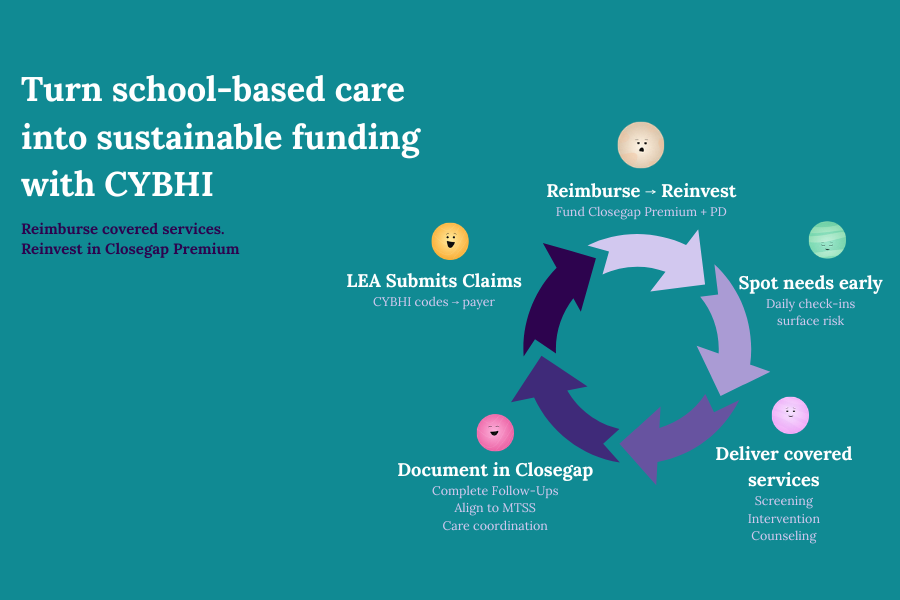
California’s Children and Youth Behavioral Health Initiative (CYBHI) Fee Schedule Program creates a new, sustainable reimbursement pathway for school-linked behavioral health services delivered to students under age 26. While CYBHI does not reimburse for software, curriculum, or professional development, it directly funds the services that school counselors, social workers, psychologists, and other qualified providers deliver every day.
Closegap aligns closely with CYBHI by helping districts:
Identify needs earlier through daily, student-driven check-ins
Guide and document billable services such as universal screening, follow progress monitoring, intervention tracking, skills-building, and care coordination
Support consistent MTSS Tier 1–3 workflows with evidence-based resources and Single-Session Interventions
Strengthen documentation quality, which is essential for accurate CYBHI claims
Expand access to preventive and early-intervention supports at no cost to families
Districts participating in CYBHI can use their reimbursement revenue to invest in tools that improve service delivery and documentation, including Closegap Premium and related professional learning.
CYBHI funds the work schools do with students, and Closegap helps make that work more efficient, more consistent, and easier to support at scale.
New York State Compliance
Ed Law 2-D Compliant
Closegap complies with New York Education Law §2-d and all associated regulations. Our policies and practices ensure that personally identifiable information (PII) is collected, used, and safeguarded solely for authorized educational purposes under school or district direction.
Key Protections:
No Sale or Commercial Use
Student data is never sold, used for advertising, or released for any commercial purpose.Data Minimization
Closegap collects only the minimum student information necessary to provide its services.Parent & Student Rights
Parents and eligible students have the right to inspect, review, and request corrections to education records through their district. Complaints regarding possible breaches of student data may be directed to the district, which will coordinate with Closegap.Teacher & Principal Data
Closegap does not collect or process teacher or principal annual professional performance review (APPR) data.Training & Access
All staff and contractors receive training on federal and state privacy laws, including Ed Law §2-d, before accessing any student data.Data Security & Encryption
Reasonable administrative, technical, and physical safeguards are in place to protect student data, including encryption while data is in motion and at rest.Breach Notification
In the event of a security breach involving student data, Closegap will notify the affected district without unreasonable delay.Data Retention & Destruction
At contract end—or at district direction—student data is returned, transferred to a successor contractor, or securely destroyed. Destruction is carried out in accordance with industry standards, and certification of destruction is available upon request. Student accounts are deleted by default after 12 months of inactivity.Third-Party Contractors
All subcontractors and service providers engaged by Closegap are bound by contractual agreements to follow the same data privacy and security requirements.
Approved in NYC Public Schools
Do you work in NYC Public Schools?
Closegap is proud to be an officially vetted and approved vendor for the New York City Department of Education. This status confirms that our platform meets the NYC DOE’s rigorous standards for data privacy, security, and educational efficacy. For NYC schools, this means a streamlined procurement process and the confidence that you are choosing a compliant, trusted solution to support your students' emotional well-being.
Illinois State Compliance (SOPPA)
Closegap complies with the Student Online Personal Protection Act (SOPPA, 105 ILCS 85), which governs operators like Closegap that receive student data from Illinois school districts.
Key Protections Under SOPPA:
No Sale or Commercial Use
Closegap does not sell student data or use it for advertising, marketing, or profiling outside of educational purposes.Parent & Student Rights
Parents and eligible students have the right to inspect, review, and request corrections to student data maintained by Closegap through their district.Security Measures
Closegap maintains reasonable administrative, technical, and physical safeguards to protect student data, including encryption in transit and at rest, access controls, and staff training.Breach Notification
In the event of a data breach involving Illinois student data, Closegap will notify the affected district without unreasonable delay, consistent with SOPPA requirements of within 30 days.Data Retention & Deletion
At contract end, or at district direction, student data is returned, transferred to a successor, or securely destroyed. Student accounts are deleted by default after 12 months of inactivity.Data Transparency
Closegap may collect the following categories of student data to provide and improve Closegap’s K-12 student support services.Basic Identifiers: first and last name, school-issued ID, grade level, teacher/classroom assignment.
Account Information: username, password, log-in email address.
Student Check-In Responses: emotional state selections, needs indicators (e.g., physical, emotional, academic), free-text optional responses.
Usage & Engagement Data: timestamps of logins/check-ins, completion status, frequency of use, tool interactions.
Device/Technical Information: IP address, browser type, operating system, and device identifiers used for session management and security.
Written Agreements
Closegap is a member of the SDPA and will enter into agreements at the district’s requests.
Ohio State Compliance
Closegap complies with all applicable student data privacy requirements under Ohio Revised Code §§ 3313.6011, 3319.321, and related state student records provisions, as well as federal laws incorporated by reference.
Key Protections in Ohio
Educational Use Only
Student data is collected and used solely for K–12 educational purposes at the direction of schools and districts.No Sale or Commercial Use
Closegap does not sell student data, use it for marketing, or allow it to be used for targeted advertising.Student Records Confidentiality
Consistent with ORC §3319.321, personally identifiable student information is treated as confidential and is not disclosed except as authorized by law or district instruction.Parent & Student Rights
Parents and eligible students maintain the right to access and request corrections to student records through their district/Data Security
Closegap implements administrative, technical, and physical safeguards appropriate to the sensitivity of student data, including encryption at rest and in transit, access controls, and staff privacy/security training.Breach Notification
In the event of a security incident involving Ohio student data, Closegap will notify the affected district without unreasonable delay.Data Retention & Deletion
At contract end, or at district direction, student data is returned, transferred, or securely destroyed in accordance with industry standards (NIST 800-88), with certification available upon request. Student accounts are deleted by default after 12 months of inactivity.
Funding Alignment
Closegap also supports Ohio districts in meeting requirements tied to the Student Wellness & Success Funds (ORC §3317.26). Our platform provides a privacy-compliant, low-barrier tool for collecting and using student well-being data to support mental health, early intervention, and whole child initiatives — directly aligning with how these funds are designed to be spent.
Alabama State Compliance
As a 501(c)(3) mental health non-profit, Closegap is committed to supporting student well-being while strictly adhering to state-specific regulations regarding parental rights and student privacy. In Alabama, the administration of student mental health surveys and assessments is governed primarily by Alabama Act 2022-442, alongside recent updates to the state's age of medical consent.
How Closegap complies with student mental health surveys in Alabama
Closegap is an educational resource designed to support districts in implementing curricular and instructional resources within their multi-tiered system of supports (MTSS). Closegap does not diagnose student mental health conditions and does not directly participate in mental health services of students. This section includes information specific to family consent laws; many districts include Closegap in their blanket consent forms to families at the start of each year. Closegap provides templates on its help center.
1. Explicit, Annual Parental Opt-In
Alabama law strictly dictates that schools must obtain specific, written permission (an "opt-in") from a parent or legal guardian before any student under the age of 14 (and up to age 16 under recent general medical consent laws) can participate in mental health services, which explicitly includes surveys and assessments.
How Closegap Complies: Closegap’s platform is built to support family engagement. We provide partner schools with templates for obtaining parental consent. School administrators can restrict student accounts which prohibit students from accessing the daily check-in and survey features. Parents may rescind consent at any time. Our system allows administrators to immediately update a student's status if a parent withdraws permission, ensuring instant compliance.
2. Transparency, Parental Review of Materials, and Ongoing Parental Communication
Schools are required by the state to notify parents at least annually about available mental health programs and provide a way for parents to review the materials used in those programs.
How Closegap Complies: Closegap provides schools with clear, comprehensive notification templates detailing the purpose and nature of our check-ins. All survey questions, emotional check-in prompts, and platform materials are designed to be easily shareable, ensuring they are readily available for parental review upon request. Districts can add parent’s and other supportive adults to each student’s account in the platform.
3. Data Privacy and Separation of Records
Alabama mandates that records pertaining to student mental health services must be treated as health care records and kept completely separate from a student's general academic records.
How Closegap Complies: Closegap data is securely hosted and structurally segregated from standard academic Student Information Systems (SIS). Access controls ensure that only specifically authorized school personnel (such as school counselors or designated mental health coordinators) are granted access to view student check-in responses.
4. The "Imminent Threat" Exception
State law allows for an exception to the parental opt-in requirement if an authorized school employee determines there is an imminent threat to the health and safety of the student or others.
How Closegap Complies: While Closegap is a proactive check-in tool, the platform is designed to flag critical emotional data. If a student's check-in responses indicate a potential crisis, the system immediately alerts designated school mental health professionals. This allows the school's trained staff to assess the situation and intervene under the imminent threat provision.
Additional Compliance Notes
Alabama extends federal protection under the Family Educational Rights and Privacy Act (FERPA, 20 U.S.C. §1232g), the Children's Online Privacy Protection Act (COPPA, 15 U.S.C. §6501 et seq.), and the Protection of Pupil Rights Amendment (PPRA, 20 U.S.C. §1232h), supplemented by the Alabama Code provisions governing public schools at Title 16, including general duties of the State Board of Education under Ala. Code §16-1-4 and Alabama Achieves accountability provisions.
Closegap complies with this framework and supports Alabama districts in meeting their student records obligations.
Key Protections in Alabama
Educational Purpose Only: Closegap acts as a "school official" with a legitimate educational interest under FERPA when handling Alabama student data, used solely for the K-12 educational purposes directed by Alabama districts.
No Targeted Advertising: Closegap does not engage in targeted advertising to students or their families based on information acquired through use of the platform for school purposes.
No Sale or Commercial Use: Student information is never sold, rented, bartered, or used for commercial profiling.
No Profiling Outside Educational Purposes: Closegap does not amass profiles of Alabama students except in furtherance of K-12 educational purposes.
No Unauthorized Disclosure: Disclosures are limited to those that further the educational purpose directed by the district, comply with law or legal processes, protect safety and security, or are made to authorized service providers under equivalent privacy and security obligations.
Reasonable Security Procedures: Closegap maintains administrative, technical, and physical safeguards appropriate to the sensitivity of student data, including encryption in transit and at rest, role-based access controls, continuous monitoring, employee privacy and security training, and incident response protocols.
Breach Notification: In the event of a security breach involving student data, Closegap will notify the affected district without unreasonable delay, supporting district compliance with the Alabama Data Breach Notification Act of 2018 (Ala. Code §8-38-1 et seq.).
Data Retention and Destruction: At contract end, or at district direction, student data is returned, transferred, or securely destroyed, with certificates of destruction available upon request. Student accounts inactive for 12 months are automatically deleted.
Parent and Student Rights: Parents and eligible students retain the right to inspect, review, and request corrections to student data through their district, consistent with FERPA.
Funding Alignment
Closegap supports Alabama districts in meeting priorities tied to several state-funded streams:
Mental Health Service Coordinator Program: Funded through the Alabama Education Trust Fund as a line item ($4.7M in FY24, $9.2M ALSDE request for FY25), this program supports a Mental Health Service Coordinator in nearly every Alabama school district. Coordinators identify students in need, link families to services, and coordinate trauma-informed responses. Closegap's daily check-in data helps Mental Health Service Coordinators surface which students need attention and when.
School Safety, Security, and Climate Line Item: Funded annually in the Alabama Education Trust Fund (approximately $11.2M in FY25), this line item includes the Bullying Prevention Project, the Mental Health Collaborative, Regional Safety Training Specialists, and the Mental Health Service Coordinators allocation. Closegap's data on student emotional state supports school climate and safety planning.
Alabama Stronger Connections Grant Program: Administered through ALSDE to high-need districts, with allowable uses including mental health professionals, Tier I and Tier II behavior and wellness supports, and MTSS-aligned programming.
Alabama MTSS Framework: ALSDE-promulgated framework prioritizing Tier I universal supports, including SEL and behavioral health screening. Closegap's universal check-in data is well-suited to the Tier I universal layer.
Alabama Department of Mental Health (ADMH) School-Based Mental Health Collaboration: ADMH receives state appropriations to initiate and expand school-based mental health programs and to support the integration of services between mental health centers and public schools.
Closegap provides a privacy-compliant, low-barrier tool for student well-being check-ins and early identification of student needs, aligning directly with Alabama's state investments in school mental health, MTSS, and school climate.
Pennsylvania State Compliance
Closegap complies with all applicable student data privacy requirements under Pennsylvania’s Public School Code (24 P.S. §13-1303a, §15-1532, and related student records provisions), as well as FERPA and other federal laws incorporated by reference.
Key Protections in Pennsylvania
Educational Purpose Only
Student data is collected and used solely for educational purposes at the direction of schools and districts.No Sale or Commercial Use
Closegap does not sell, lease, or trade student data, nor use it for advertising, marketing, or non-educational profiling.Student Records Confidentiality
Consistent with 24 P.S. §15-1532 and 24 P.S. §13-1303a, personally identifiable information is treated as confidential and is not disclosed except as authorized by law or district instruction.Parent & Student Rights
Parents and eligible students retain the right to inspect, review, and request corrections to student data through their district, consistent with Pennsylvania law and FERPA.Data Security
Closegap uses administrative, technical, and physical safeguards appropriate to the sensitivity of student data, including encryption at rest and in transit, access controls, monitoring, and staff privacy/security training.Breach Notification
In the event of a security incident involving Pennsylvania student data, Closegap will notify the affected district without unreasonable delay.Data Retention & Deletion
At contract end, or at district direction, student data is returned, transferred to a successor, or securely destroyed - with certificates available upon request. Student accounts are deleted by default after 12 months of inactivity.
Funding Alignment
Closegap also supports Pennsylvania districts in meeting requirements tied to the Student Mental Health Supports and Safe Schools initiatives. By providing a low-barrier, privacy-compliant tool for student well-being check-ins and data-informed early interventions, Closegap aligns with state priorities for improving student safety, access to mental health supports, and whole-child outcomes. This includes:
Pennsylvania Commission on Crime and Delinquency (PCCD) School Safety and Security Grant Program: Pennsylvania's signature state-funded school safety program, established by Act 44 of 2018 and expanded by subsequent legislation including the Pennsylvania School Safety and Mental Health Investment of 2022. The program provides competitive grants to Pennsylvania school districts and intermediate units for school safety, behavioral health, and mental health initiatives. Allowable uses include hiring school counselors, school psychologists, school social workers, school nurses, and contracted behavioral health providers; purchasing and implementing mental health screening tools; implementing trauma-informed practices; and other school safety and mental health initiatives. Closegap is allowable as a screening tool and mental health support resource under the program.
PCCD Student Behavioral Health Investment: A state-funded grant initiative within PCCD's broader portfolio specifically supporting Pennsylvania school district investments in student behavioral health, including school-based mental health services.
PDE Office for Safe Schools: A PDE office providing leadership, professional development, and technical assistance for Pennsylvania school safety, school counseling, and student support services.
Pennsylvania Office of Mental Health and Substance Abuse Services (OMHSAS): Pennsylvania's State Mental Health Authority, providing state-funded community-based behavioral health services through County Mental Health/Intellectual Disability (MH/ID) Programs and HealthChoices Behavioral Health that partner with Pennsylvania school districts.
Pennsylvania Student Assistance Program (SAP): A long-running state-mandated program in Pennsylvania school districts providing K-12 student behavioral health early identification, referral, and follow-up. SAP teams operate in every Pennsylvania school district. Closegap supports SAP teams by surfacing students for follow-up.
Act 71 (2014) Suicide Prevention: A Pennsylvania law requiring suicide awareness and prevention training for school personnel and providing guidance for student suicide prevention curriculum.
Pennsylvania Multi-Tiered System of Supports (MTSS): A state-supported framework administered by PDE integrating academic, behavioral, and social-emotional support across tiers. Closegap fits the Tier I universal layer.
Pennsylvania Network for Student Assistance Services (PNSAS): A state-supported network providing technical assistance, training, and resources to Pennsylvania SAP teams.
988 Pennsylvania Suicide and Crisis Lifeline: Pennsylvania's state-administered 988 service providing 24/7 crisis support.
Washington State Compliance
Closegap complies with Washington’s Student User Privacy in Education Rights (SUPER) Act (RCW 28A.604), which protects the privacy and security of K–12 student data used by online service providers.
Key Protections in Washington
Educational Purpose Only
Closegap collects and uses student data solely for educational purposes directed by schools and districts.No Sale or Targeted Advertising
Closegap does not sell student data, nor use it for targeted advertising, marketing, or profiling outside of educational purposes.Student Records Confidentiality
Personally identifiable student information is treated as confidential and is not disclosed except as authorized by law or district instruction, consistent with RCW 28A.604 and FERPA.Parent & Student Rights
Parents and eligible students retain the right to access, review, and request corrections to student data through their district.Security Measures
Closegap maintains reasonable administrative, technical, and physical safeguards to protect student data, including encryption of data in transit and at rest, access controls, monitoring, and staff training.Breach Notification
In the event of a security incident involving Washington student data, Closegap will notify the affected district without unreasonable delay.Data Retention & Deletion
At contract end—or at district direction—student data is returned, transferred to a successor, or securely destroyed in accordance with industry standards (e.g., NIST 800-88), with certification available upon request.
SEBMH Plan Coordination (RCW §28A.320.127)
Consistent with RCW §28A.320.127, all Washington K-12 school districts must adopt a plan to screen, recognize, and respond to indicators of social, emotional, behavioral, and mental health (SEBMH), including sexual abuse, substance use, violence, and youth suicide. The OSPI/University of Washington SMART Center developed a model district template for SEBMH recognition, screening, and response. Closegap fits cleanly into the SEBMH plan as a Tier 1 universal recognition and screening layer aligned with the model template.
Alignment
Closegap supports Washington school districts in meeting priorities tied to several state-funded streams:
ESD Behavioral Health System Navigators (2SHB 1216, 2019-20): A state-funded program placing Behavioral Health Coordinator/Navigator (BHN) positions in all nine of Washington's Educational Service Districts. BHNs are responsible for bridging the education and behavioral health systems, with the goal of reducing access barriers to behavioral health services for Washington students and their families. Closegap's daily check-in data supports BHNs by surfacing students for follow-up.
HB 1664 (2022) School Staffing: A state law providing funding and incentives for Washington schools to increase the number of staff who provide physical, social, and emotional support to students. Schools must report to the state how funds were used for hiring staff that directly support students.
OSPI Student Assistance Prevention-Intervention Services Program (SAPISP): A long-running state and federally-funded comprehensive integrated model of services that fosters safe school environments, promotes healthy childhood development, and prevents alcohol, tobacco, and other drug abuse. SAPISP places professional staff in Washington schools to implement comprehensive student assistance programs.
Health Care Authority (HCA) Medicaid School-Based Behavioral Health Services: Washington's Medicaid school-based behavioral health services framework, supported by the OSPI Medicaid School-based Behavioral Health Services and Billing Toolkit. Closegap supports Washington districts in identifying students who may benefit from Medicaid-eligible school-based behavioral health services.
HB 1834 (2022) Mental Health Absences: A state law establishing student absence from school for mental health reasons as an excused absence in Washington.
OSPI School Safety Center: A state-administered center providing leadership, professional development, and technical assistance for Washington school safety and behavioral health, in partnership with the OSPI Mental, Social, & Behavioral Health team.
Secondary Traumatic Stress (RCW §28A.300.825): A state framework supporting Washington educators in addressing secondary traumatic stress, with required district policies and procedures and dedicated professional learning days every other school year.
Washington Multi-Tiered System of Supports (MTSS): A state-supported framework, with OSPI awarded a five-year, $5.3 million grant from the U.S. Department of Education (2021) to help Washington districts implement MTSS. Closegap fits the Tier I universal layer.
HearMeWA: A state-funded 24/7 secure support service for Washington youth.
988 Washington Suicide and Crisis Lifeline: Washington's state-administered 988 service providing 24/7 crisis support.
Arizona State Compliance
Closegap complies with Arizona’s Student Data Privacy Law (ARS §15-1046, as amended by SB 1314 and related statutes), which governs the collection, use, and disclosure of K–12 student data by online service providers.
Key Protections in Arizona
Educational Purpose Only
Student data is collected and used solely for K–12 school purposes at the direction of Arizona schools and districts.No Sale or Targeted Advertising
Closegap does not sell student data or use it for targeted advertising, marketing, or profiling beyond educational purposes.Student Records Confidentiality
Personally identifiable student information is treated as confidential and is not disclosed except as authorized by law or district instruction.Parent & Student Rights
Consistent with A.R.S. §15-117, Closegap recognizes Arizona's framework requiring parental notification, parental consent, and the right to inspect for surveys, analyses, evaluations, or questionnaires that reveal certain protected information categories. Parents and eligible students retain the right to access, review, and request corrections to student data through their district. Closegap supports school and districts in providing parents with notice and opt-out opportunities before releasing directory information.Data Deletion
At a district’s request, Closegap will delete covered student information under its control within a reasonable timeframe. Student accounts are automatically deleted 12-months after inactivity. Certificates of deletion are available upon request.Security Measures
Closegap employs reasonable administrative, technical, and physical safeguards to protect student data, including encryption in transit and at rest, access controls, and staff privacy/security training.Breach Notification
In the event of a security incident involving Arizona student data, Closegap will notify the affected district without unreasonable delay.
Funding Alignment
Closegap also supports Arizona districts in meeting objectives tied to School Safety and Student Support initiatives, including state investments in school counselors, social workers, and mental health resources. Our platform provides a privacy-compliant, low-barrier tool for student well-being check-ins and early intervention, directly aligning with Arizona’s funding priorities around school safety and student wellness.
Michigan State Compliance
Closegap complies with Michigan’s Student Online Personal Protection Act (SOPPA, Public Act 197 of 2020) and related provisions under the Michigan Revised School Code, which govern the collection, use, and protection of K–12 student data by online service providers.
Key Protections in Michigan
Educational Purpose Only
Student data is collected and used solely for K–12 educational purposes at the direction of Michigan schools and districts.No Sale or Targeted Advertising
Closegap does not sell student data or use it for targeted advertising, marketing, or profiling outside of educational purposes.Student Records Confidentiality
Personally identifiable student information is treated as confidential and is not disclosed except as authorized by law or district instruction, consistent with Michigan law and FERPA.Parent & Student Rights
Parents and eligible students retain the right to inspect, review, and request corrections to student data through their district.Data Transparency
In alignment with Michigan SOPPA, Closegap provides districts with:A description of the student data elements collected (basic identifiers, account credentials, check-in responses, usage data, technical session data).
The educational purposes for which data is used.
A list of subcontractors with access to student data, bound by equivalent privacy and security obligations.
Data retention and destruction practices.
Security Measures
Closegap implements reasonable administrative, technical, and physical safeguards to protect student data, including encryption at rest and in transit, access controls, and staff privacy/security training.Breach Notification
In the event of a security incident involving Michigan student data, Closegap will notify the affected district without unreasonable delay.Data Retention & Deletion
At contract end—or at district direction—student data is returned, transferred to a successor, or securely destroyed in accordance with industry standards (e.g., NIST 800-88), with certification available upon request.
Funding Alignment
Closegap also supports Michigan districts in meeting priorities tied to 31n Mental Health and Student Wellness funds and other state mental health grant programs. Our platform provides a privacy-compliant, low-barrier tool for student well-being check-ins, early identification of needs, and data to support whole-child initiatives, aligning directly with Michigan’s focus on expanding access to school-based mental health supports.
Texas State Compliance
Closegap complies with Texas’s Student Data Privacy and Security Act (SB 820, Tex. Educ. Code §32.151 et seq.) and related provisions of the Texas Education Code, which require strong data privacy and cybersecurity protections for K–12 student information.
Key Protections in Texas
Educational Purpose Only
Student data is collected and used solely for educational purposes at the direction of Texas schools and districts.No Sale or Targeted Advertising
Closegap does not sell student data or use it for targeted advertising, marketing, or profiling outside of educational purposes.Student Records Confidentiality
Personally identifiable student information is treated as confidential and is not disclosed except as authorized by law or district instruction, consistent with Texas law and FERPA.Parent & Student Rights
Parents and eligible students retain the right to access, review, and request corrections to student data through their district.Cybersecurity Alignment
Closegap aligns with the cybersecurity requirements established by SB 820, which mandate that school districts adopt a framework based on nationally recognized standards (e.g., NIST). Closegap maintains administrative, technical, and physical safeguards consistent with these standards, including encryption, access controls, monitoring, and incident response protocols.Breach Notification
In the event of a security incident involving Texas student data, Closegap will notify the affected district without unreasonable delay and consistent with applicable law and contractual requirements.Data Retention & Deletion
At contract end—or at district direction—student data is returned, transferred to a successor, or securely destroyed in accordance with industry standards (e.g., NIST 800-88), with certification available upon request.
SB12 & Closegap Compliance
Texas Senate Bill 12, the Parents' Bill of Rights, establishes new parental consent and notification requirements for K-12 health-related services, effective September 1, 2025. Here’s how Closegap complies with each requirement:
Written parental consent before administering well-being questionnaires or health screenings.
Districts manage parental consent in accordance with district policy. Closegap provides family communication templates in English and Spanish that districts can adapt for opt-in or opt-out implementation, and remains fully compliant with FERPA and COPPA.
Written parental consent before psychological exams or treatments.
Closegap is not a psychological exam or clinical treatment. It is not diagnostic; it is a student-driven self-reflection tool and not a replacement for clinical care.
Start-of-year written notice of each health-related service offered, including the parent's right to withhold consent.
Districts can adapt Closegap’s family communication templates for start-of-year notices about student well-being services. See sample forms on Closegap’s Help Center.
Notification of any change in services provided to, or monitoring of, a student's mental, emotional, or physical health.
Closegap supports districts in notifying families as part of any service change. See sample forms on Closegap’s Help Center.
No collection or disclosure of biometric or medical information without written consent.
Closegap does not collect biometric data, medical records, or connect to health insurance or clinical EHR systems.
Parents retain the right to access information related to their child.
Parents can request their child's check-in history, or request to be added to their child’s account to view and respond to check-in data, at any time through their district. Closegap supports districts in fulfilling these requests.
Funding Alignment
Closegap also supports Texas districts in meeting priorities tied to Safe and Supportive Schools, Texas Mental Health Grants, and School Safety Allotment funds. Our platform provides a privacy-compliant, low-barrier tool for student well-being check-ins, early identification of student needs, and data to support MTSS and whole-child initiatives, aligning directly with state funding objectives for mental health and school safety.
Massachusetts State Compliance
Closegap complies with the Massachusetts Student Records Regulations at 603 CMR 23.00, promulgated under M.G.L. c. 71, §§34D-34H, which work alongside the federal Family Educational Rights and Privacy Act (FERPA) to govern the maintenance, access, confidentiality, amendment, and destruction of student records in Massachusetts public schools and in private schools with publicly funded special education programs.
Key Protections in Massachusetts
Educational Purpose Only: Closegap acts as a "school official" with a legitimate educational interest under FERPA and as authorized school personnel under 603 CMR 23.02 when handling Massachusetts student data, used solely for the K-12 school purposes directed by the Local Education Agency (LEA).
No Targeted Advertising: Closegap does not engage in targeted advertising to students or their families based on information acquired through use of the platform for school purposes.
No Sale or Commercial Use: Student information is never sold, rented, or used for marketing or commercial profiling.
No Unauthorized Disclosure: Consistent with 603 CMR 23.07, Closegap does not disclose personally identifiable information from a student record to a third party without the written consent of the parent or eligible student, except in the limited circumstances permitted under 34 C.F.R. §§99.30, 99.31 and 603 CMR 23.07(4).
Eligible Student Rights at Age 14: Closegap recognizes that under 603 CMR 23.01, students aged 14 or in the 9th grade and above are "eligible students" who share with their parents the rights of confidentiality, inspection, amendment, and destruction. Either the eligible student or the parent, acting alone, may exercise those rights. Closegap supports districts in honoring this dual-rights framework.
Privacy and Security of Records: Consistent with 603 CMR 23.05, Closegap maintains administrative, technical, and physical safeguards to keep student data physically and digitally secure, including encryption in transit and at rest, role-based access controls, continuous monitoring, and staff training.
Breach Notification: In the event of a security breach involving Massachusetts student data, Closegap will notify the affected district without unreasonable delay, supporting district compliance with M.G.L. c. 93H, §3.
Data Retention and Destruction: At contract end, or at district direction, student data is returned, transferred, or securely destroyed, with certificates of destruction available upon request. Student accounts inactive for 12 months are automatically deleted. Closegap recognizes that under 603 CMR 23.06, transcripts must be retained by the school for at least 60 years and temporary records must be destroyed no later than seven years after the student leaves the school system; Closegap's role is limited to the data shared with it under the LEA's data privacy agreement.
Parent, Guardian, and Eligible Student Rights of Inspection and Amendment: Parents, guardians, and eligible students retain the rights of inspection (603 CMR 23.07), amendment (603 CMR 23.08), and procedural due process (603 CMR 23.09), exercised through their LEA. Closegap supports LEAs in fulfilling these requests.
Massachusetts Student Data Privacy Agreement (MA-DPA)
Massachusetts maintains an active Student Data Privacy Agreement framework administered through the Student Data Privacy Consortium (SDPC). Closegap is a member of the SDPC.
Funding Alignment
Closegap supports Massachusetts districts in meeting priorities tied to several state-funded streams:
DESE Supporting Students' SEL, Behavioral & Mental Health, and Wellness Grant (Fund Code 0311): A state-funded competitive grant administered by the Massachusetts Department of Elementary and Secondary Education (DESE), with approximately $5-7M available annually. The grant prioritizes universal mental health and social-emotional screening systems, evidence-based interventions across MTSS tiers, and sustainable systems and partnerships. Closegap's voluntary universal check-in fits directly into the universal screening priority.
DESE Multi-Tiered System of Supports (MTSS) Blueprint: Updated in 2018, the MTSS Blueprint integrates social-emotional, behavioral, and academic learning, with explicit focus on equitable access and Universal Design for Learning. Closegap's daily data supports the Tier I universal layer.
DESE Social, Emotional, and Behavior (SEB) Academy: A state-funded academy administered through Education Development Center offering intensive coaching and technical assistance to participating Massachusetts schools and districts on building evidence-based, data-driven, culturally responsive MTSS systems.
DESE Safe and Supportive Schools Framework and Self-Reflection Tool: A state-supported framework for schools and districts to assess and strengthen safe and supportive school environments. Closegap's data on student emotional state supports the framework's well-being domains.
Universal Mental Health and Social-Emotional Screening Pilot: DESE has supported Universal Screening Pilot grants under Fund Code 0311, with awardees expanding screening tools and protocols. Closegap's voluntary check-in is well-suited to the screening pilot use case.
Massachusetts School-Based Medicaid Program: Allowable expenditures for student behavioral health supports, where applicable under district plans.
Nebraska State Compliance
Closegap complies with Nebraska's Student Online Personal Protection Act (SOPPA, Neb. Rev. Stat. §79-2,154 et seq., enacted 2017), which restricts how operators of K-12 online services may use, disclose, and retain Nebraska student information, alongside the federal Family Educational Rights and Privacy Act (FERPA), Nebraska's student records statute at Neb. Rev. Stat. §79-2,104, and the Nebraska Department of Education student records regulations at Title 92 NAC Chapter 6.
Key Protections in Nebraska
Educational Purpose Only: Closegap operates as an "online operator" under Nebraska's SOPPA, with the platform designed and marketed for K-12 school purposes. Nebraska student data is collected and used solely for the educational purposes directed by Nebraska districts and Educational Service Units (ESUs).
No Targeted Advertising: Consistent with Nebraska's SOPPA, Closegap does not use personal information obtained from Nebraska students for targeted advertising on the platform or elsewhere.
No Sale or Rental of Student Data: Closegap does not sell, rent, or barter Nebraska student information, except in connection with a merger or acquisition where the successor entity assumes equivalent privacy obligations.
No Profiling Outside Educational Purposes: Closegap does not amass profiles of Nebraska students except in furtherance of K-12 school purposes.
No Unauthorized Disclosure: Disclosures are limited to those authorized under Nebraska's SOPPA, including disclosures necessary to provide the educational service, to comply with legal process, to protect safety and integrity of users or the service, or to authorized subcontractors bound by equivalent obligations.
Reasonable Security Procedures: Closegap maintains administrative, technical, and physical safeguards appropriate to the sensitivity of student data, including encryption in transit and at rest, role-based access controls, continuous monitoring, and staff privacy and security training.
Breach Notification: In the event of a security breach involving Nebraska student data, Closegap will notify the affected district without unreasonable delay, supporting district compliance with Nebraska's Financial Data Protection and Consumer Notification of Data Security Breach Act (Neb. Rev. Stat. §87-801 et seq.).
Data Retention and Destruction: At contract end, or at district direction, student data is returned, transferred, or securely destroyed, with certificates of destruction available upon request. Student accounts inactive for 12 months are automatically deleted.
Parent and Student Rights: Consistent with Neb. Rev. Stat. §79-2,104, parents, guardians, and students of majority age retain the right to inspect, review, and obtain copies of student records through their district, with disciplinary material removed and destroyed after three years of continuous absence.
Nebraska Data Privacy Act (LB 1074, 2024)
The Nebraska Data Privacy Act, signed April 17, 2024, and effective January 1, 2025, establishes a comprehensive consumer privacy framework with controller and processor obligations modeled on the Iowa and Connecticut frameworks. Two features bear directly on Closegap's posture in Nebraska:
Data Limitation and Security Obligations: Even where exempt from specific provisions, Closegap applies the Act's principles of data minimization, purpose limitation, and reasonable security across all data, consistent with industry best practice.
Education and Nonprofit Considerations: The Act includes exemptions for FERPA-regulated data and for entities meeting specified consumer thresholds. Closegap operates as a nonprofit and handles student data under the FERPA framework.
Nebraska Student Data Privacy Agreement
Nebraska is a participating state in the Student Data Privacy Consortium (SDPC) and maintains a Nebraska Student Data Privacy Agreement template. Closegap is prepared to enter into the Nebraska SDPC DPA with Nebraska districts.
Funding Alignment
Closegap supports Nebraska districts and ESUs in meeting priorities tied to several state-funded streams:
NDE Office of Coordinated Student Support Services (CSSS): A state office that coordinates support related to overall mental and physical health and safety of students, including MTSS-B implementation, school-based mental health systems, and crisis response.
Nebraska Multi-Tiered System of Support — Behavioral (MTSS-B): Nebraska's behavioral MTSS framework provides a tiered structure for universal, targeted, and intensive supports. Closegap's universal check-in fits the Tier I universal layer.
Nebraska Positive Behavioral Interventions and Support (NPBIS): A state-supported initiative under the NDE that provides evidence-based PBIS training and technical assistance to Nebraska schools.
Educational Service Units (ESUs): Nebraska's 17 ESUs are state-supported regional service agencies that provide professional development, technical assistance, and shared services for member districts, including mental health systems support.
Nebraska School Mental Health Systems Initiative: An NDE-led initiative providing professional development and technical assistance to school districts on building comprehensive school mental health systems.
h certificates of destruction available upon request. Student accounts inactive for 12 months are automatically deleted. Closegap recognizes that under 603 CMR 23.06, transcripts must be retained by the school for at least 60 years and temporary records must be destroyed no later than seven years after the student leaves the school system; Closegap's role is limited to the data shared with it under the LEA's data privacy agreement.
Parent, Guardian, and Eligible Student Rights of Inspection and Amendment: Parents, guardians, and eligible students retain the rights of inspection (603 CMR 23.07), amendment (603 CMR 23.08), and procedural due process (603 CMR 23.09), exercised through their LEA. Closegap supports LEAs in fulfilling these requests.
Vermont State Compliance
Closegap complies with Vermont's student privacy law codified at 9 V.S.A. §§2443 and 2443a (Added 2019, No. 89, Adj. Sess., effective July 1, 2020), which restricts how "operators" of K-12 websites, online services, and applications may collect, use, disclose, and retain "covered information" from Vermont students. Closegap also follows the Vermont Agency of Education's data governance guidance and Vermont State Board of Education Rule 2555 regarding student confidentiality.
Key Protections in Vermont
Educational Purpose Only: Closegap operates as an "operator" under 9 V.S.A. §2443. Vermont student data is collected and used solely for the PreK-12 school purposes directed by Vermont supervisory unions, supervisory districts, and independent schools.
No Targeted Advertising: Consistent with 9 V.S.A. §2443a(a)(1), Closegap does not engage in targeted advertising based on information acquired through use of the platform for PreK-12 school purposes.
No Profiling Outside Educational Purposes: Consistent with 9 V.S.A. §2443a(a)(2), Closegap does not use covered information to amass a profile of a Vermont student except for PreK-12 school purposes.
No Sale or Rental of Student Data: Consistent with 9 V.S.A. §2443a(a)(3), Closegap does not sell, barter, or rent any Vermont student's covered information.
No Unauthorized Disclosure: Consistent with 9 V.S.A. §2443a(a)(4), disclosures of covered information to third parties are limited to those expressly permitted by statute, including disclosures required by federal or State law, legitimate research subject to applicable restrictions, the educational purpose for which the data was collected, and disclosures to authorized service providers contractually bound to equivalent obligations and prohibited from further disclosure or commercial use.
Reasonable Security Procedures: Consistent with 9 V.S.A. §2443a(b)(1), Closegap implements and maintains reasonable security procedures and practices appropriate to the nature of the covered information, including encryption in transit and at rest, role-based access controls, continuous monitoring, and staff training.
Breach Notification: In the event of a security incident involving Vermont student data, Closegap will notify the affected LEA without unreasonable delay, supporting district compliance with Vermont's expanded Security Breach Notice Act under 9 V.S.A. §§2435 and 2436, which now covers online account credentials, health and medical information, and biometric and genetic data.
Data Deletion at District Request: Consistent with 9 V.S.A. §2443a(b)(2), Closegap will delete a student's covered information within a reasonable time period at the request of the school or school district, unless the student or parent consents to maintenance of the information. Student accounts inactive for 12 months are automatically deleted, and certificates of destruction are available upon request.
Public Disclosure of Practices: Consistent with 9 V.S.A. §2443a(b)(3), Closegap publicly discloses material information about its collection, use, and disclosure of covered information through its terms of service and privacy policy.
Parent, Guardian, and Eligible Student Rights: Parents, legal guardians, and eligible students retain the right to inspect, review, and request corrections to student data through their LEA.
Vermont Student Data Privacy Agreement: Closegap is prepared to enter into the Vermont K-12 Student Data Privacy Agreement administered through the Student Data Privacy Consortium (SDPC) with Vermont LEAs. Vermont's participation in the SDPC is coordinated through the Vermont Agency of Education.
Funding Alignment
Closegap supports Vermont districts and supervisory unions in meeting priorities tied to several state-funded streams:
Act 112 of 2022 (Grants to Expand Mental Health and Well-Being Services to Youth): Vermont state-funded grants administered jointly by the Agency of Education and Department of Mental Health to expand school mental health services. Closegap aligns with Act 112's emphasis on prevention and early intervention.
Act 230 (Educator Training in Academic and Social-Emotional-Behavioral Support): Vermont state funds supporting training of teachers, administrators, and other personnel in providing education services to students requiring academic and social/emotional/behavioral support. Closegap's data supports educators in identifying and responding to student need.
Act 67 (Community Schools): Vermont state-funded grants for Community Schools that serve as resource hubs for coordinated student and family support.
Vermont Multi-Tiered System of Supports (VTmtss) Framework: A state framework integrating academic and social-emotional learning across tiers. Closegap's universal check-in fits the Tier I universal layer.
Vermont Universal Screening Guidelines for Social, Emotional, and Behavioral Needs and Strengths: State-issued guidelines from the Agency of Education supporting LEA universal screening of students. Closegap's voluntary daily check-in is well-suited to this guidance.
Vermont School Mental Health Systems Toolkit: State-issued toolkit jointly developed by the Agency of Education and the Department of Mental Health to support assessment, prioritization, and funding of school-based mental health services.
Success Beyond Six: Vermont's longstanding Medicaid school-based services mechanism (operating since 1992) supporting partnerships between mental health, education, and families through Designated Agencies.
West Virginia State Compliance
Closegap complies with West Virginia's Student Data Accessibility, Transparency and Accountability Act (SDATAA, W. Va. Code §18-2-5h, enacted 2014), which establishes parental rights, data governance requirements, and contractor obligations for vendors handling West Virginia student data, alongside the federal Family Educational Rights and Privacy Act (FERPA).
Key Protections in West Virginia
Educational Purpose Only: Closegap acts as a "school official" with a legitimate educational interest under FERPA when handling West Virginia student data, used solely for the K-12 educational purposes directed by West Virginia county boards of education.
No Targeted Advertising: Closegap does not engage in targeted advertising to students or their families based on information acquired through use of the platform for school purposes.
No Sale, Transfer, or Sharing for Commercial Purposes: Consistent with the policy intent of W. Va. Code §18-2-5h and subsequent legislative refinements, Closegap does not sell, transfer, or share West Virginia student data with vendors or other profit-making entities for commercial purposes.
No Unauthorized Disclosure: Disclosures are limited to those that further the educational purpose directed by the county board of education, comply with law or legal processes, protect safety and security, or are made to authorized service providers under equivalent privacy and security obligations.
Vendor Privacy and Security Provisions: Consistent with W. Va. Code §18-2-5h(f)(7), which requires that "any contracts that govern databases, assessments or instructional supports that include student or redacted data and are outsourced to private vendors include express provisions that safeguard privacy and security and include penalties for noncompliance," Closegap's data privacy agreements with West Virginia districts include these provisions.
Aggregate and Redacted Data Standards: Closegap supports West Virginia districts in meeting the aggregate and redacted data standards established under W. Va. Code §18-2-5h(b), including reporting at the group, cohort, or institutional level and removing parent and student identifying information for non-instructional uses.
Reasonable Security Procedures: Closegap maintains administrative, technical, and physical safeguards including encryption in transit and at rest, role-based access controls, employee training, and incident response protocols, consistent with the data security policies framework under W. Va. Code §18-2-5h(f).
Breach Notification: In the event of a security breach involving West Virginia student data, Closegap will notify the affected county board of education without unreasonable delay, supporting district compliance with the West Virginia Consumer Credit and Protection Act breach notification provisions under W. Va. Code §46A-2A-101 et seq.
Data Retention and Destruction: At contract end, or at district direction, student data is returned, transferred, or securely destroyed, with certificates of destruction available upon request. Student accounts inactive for 12 months are automatically deleted.
Parental Rights Regarding Education Records: Consistent with W. Va. Code §18-2-5h(g), parents have the right to inspect and review their child's education record maintained by the school and to request student data specific to their child's educational record. School districts must provide parents with a copy of their child's educational record upon request, and Closegap supports districts in fulfilling these requests.
Funding Alignment
Closegap supports West Virginia districts in meeting priorities tied to several state-funded streams:
West Virginia Expanded School Mental Health (ESMH) Framework: A jointly sponsored framework of the West Virginia Department of Education (WVDE) and the West Virginia Department of Human Services, Bureau for Behavioral Health (WVDoHS BBH), supporting a multi-tiered model of prevention, early intervention, and treatment. WVDoHS BBH funds approximately 75 ESMH sites through state grant funding to qualified mental health agencies. Closegap's daily check-ins and MTSS-aligned dashboards complement the prevention and early intervention tiers of ESMH.
WVBE Policy 2315 (Comprehensive School Counseling Programs): West Virginia Board of Education policy requiring comprehensive school counseling programs and assigning school counselors a leadership role in mental health crisis response. Closegap's data supports counselors in identifying students needing follow-up.
West Virginia School Learning Environment Survey: A WVDE-administered survey supporting data-driven planning at the county and school level. Closegap's data complements the survey at the daily and individual-student level.
WVDE Office of Student Support and Well-Being: A state office coordinating mental, behavioral, and physical health programs and initiatives across West Virginia schools.
Connecticut State Compliance
Closegap complies with Connecticut's Student Data Privacy Act (Conn. Gen. Stat. §§10-234aa through 10-234dd), originally enacted as P.A. 16-189, amended by P.A. 17-200 and P.A. 18-125, which restricts how "contractors," "operators," and "consultants" may collect, use, retain, and disclose student information from Connecticut local and regional boards of education.
Key Protections in Connecticut
Operator and Contractor Status: Closegap operates as an "operator" under Conn. Gen. Stat. §10-234aa(2) when its service is used for school purposes and was designed and marketed for school purposes. When Closegap enters into a written contract with a Connecticut local or regional board of education, it also acts as a "contractor" under §10-234aa(1). Closegap acts as a "school official" with a legitimate educational interest under FERPA, used solely for the school purposes directed by the local or regional board of education.
No Targeted Advertising: Consistent with Conn. Gen. Stat. §10-234dd, Closegap does not use student information acquired through use of the platform for school purposes to engage in targeted advertising on the platform or elsewhere.
No Profiling Outside Educational Purposes: Closegap does not use student information to amass a profile of a Connecticut student for purposes other than school purposes.
No Sale or Disclosure of Student Information: Closegap does not sell, rent, or otherwise disclose Connecticut student information except as expressly permitted by Conn. Gen. Stat. §§10-234bb and 10-234dd, including disclosures necessary to provide the educational service, to comply with federal or state law, to ensure the integrity of the platform, or to authorized service providers contractually bound to equivalent obligations.
Student-Generated Content: Consistent with Conn. Gen. Stat. §10-234bb(b), Closegap recognizes that all student-generated content remains the property of the student or the student's parent or legal guardian.
Reasonable Security Procedures: Consistent with Conn. Gen. Stat. §10-234dd(b)(1), Closegap maintains reasonable security procedures and practices appropriate to the nature of the student information, including encryption in transit and at rest, role-based access controls, continuous monitoring, employee privacy and security training, and incident response protocols.
Breach Notification: In the event of a security breach involving Connecticut student information, Closegap will notify the affected board of education without unreasonable delay, supporting district compliance with Conn. Gen. Stat. §10-234dd(d) and §36a-701b.
Data Retention and Destruction: Consistent with Conn. Gen. Stat. §10-234bb, at contract end, or at district direction, student data is returned, transferred, or securely destroyed, with certificates of destruction available upon request. Student accounts inactive for 12 months are automatically deleted.
Parent and Student Rights: Parents and eligible students retain the right to inspect, review, and request corrections to student data through their local or regional board of education.
Notice to Parents and Guardians: Consistent with Conn. Gen. Stat. §10-234bb, Closegap supports districts in providing the required parent and guardian notice within five business days of contract execution, including the identity of the contractor, the categories of student information collected, the purposes of collection, and parent and guardian rights.
Funding Alignment
Closegap supports Connecticut districts in meeting priorities tied to several state-funded streams:
Connecticut Statewide SEL Initiative (Public Act 19-166): Establishes the state's definition of social-emotional learning and is supported through CSDE guidance, professional development, and resources.
CSDE Academic Office, Social-Emotional Learning Hub: A state-managed hub providing CASEL-aligned resources, professional development, and a Parent Toolkit.
CSDE Multi-Tiered System of Supports (MTSS): A CSDE-supported framework for academic, social-emotional, and behavioral supports.
Maine State Compliance
Closegap complies with Maine's Student Information Privacy Act (SIPA, 20-A M.R.S. §§951-954, enacted as P.L. 2015, ch. 256, amended by P.L. 2017, ch. 288), which restricts how "operators" of K-12 websites, online services, and applications may collect, use, disclose, and retain Maine student personally identifiable information, alongside Maine's broader student records statute at 20-A M.R.S. §6001 and the Family Educational Rights and Privacy Act (FERPA).
Key Protections in Maine
Educational Purpose Only: Closegap operates as an "operator" under 20-A M.R.S. §952(4). Maine student data is collected and used solely for the K-12 school purposes directed by Maine school administrative units (SAUs) and schools.
No Targeted Advertising: Consistent with 20-A M.R.S. §953(1)(A), Closegap does not use Maine student data to engage in targeted advertising on the platform or on any other website, service, or application based on student data and persistent unique identifiers acquired through the school-use service.
No Profiling Outside Educational Purposes: Consistent with 20-A M.R.S. §953(1)(B), Closegap does not use Maine student data to amass a profile of a Maine student except for K-12 school purposes.
No Sale of Student Data: Consistent with 20-A M.R.S. §953(1)(C), Closegap does not sell Maine student data, except in connection with a merger, acquisition, or other type of acquisition of an operator by another entity where the successor entity assumes equivalent obligations.
Limited Disclosure: Consistent with 20-A M.R.S. §953(1)(D) and §953(3), Closegap does not disclose Maine student personally identifiable information except in the limited circumstances expressly permitted by statute, including disclosures required by federal or state law, disclosures for legitimate research purposes subject to applicable restrictions, and disclosures to state agencies, school administrative units, or schools for K-12 purposes as permitted by law.
Reasonable Security Procedures: Consistent with 20-A M.R.S. §953(2)(A), Closegap implements and maintains reasonable security procedures and practices appropriate to the nature of the student data, including encryption in transit and at rest, role-based access controls, continuous monitoring, and staff training.
45-Day Deletion at District Request: Consistent with 20-A M.R.S. §953(2)(B), Closegap will delete a student's data within 45 days of a request from a Maine school or school administrative unit. Student accounts inactive for 12 months are automatically deleted, and certificates of destruction are available upon request.
Breach Notification: In the event of a security breach involving Maine student data, Closegap will notify the affected SAU without unreasonable delay, supporting SAU compliance with the Maine Notice of Risk to Personal Data Act, 10 M.R.S. §§1346-1350, which expressly covers municipalities and school administrative units.
Section 6001 Compatibility: Consistent with 20-A M.R.S. §953(4)(I), Closegap does not authorize any dissemination of information that would violate 20-A M.R.S. §6001, Maine's student records dissemination law.
Parent, Guardian, and Eligible Student Rights: Parents, legal guardians, and eligible students retain the right to inspect, review, and request corrections to student data through their SAU, consistent with FERPA, 20-A M.R.S. §6001, and Maine Unified Special Education Regulation (MUSER) Chapter 101, §XIV.
Maine Student Privacy Alliance (MSPA)
Maine is a participating state in the Student Data Privacy Consortium (SDPC) through the Maine Student Privacy Alliance (MSPA) and maintains a Maine K-12 Student Data Privacy Agreement template. Closegap is a member of the SDPC.
Funding Alignment
Closegap supports Maine districts in meeting priorities tied to several state-administered streams:
Maine MTSS Framework: A state-required Multi-Tiered System of Supports framework administered through the Maine Department of Education (DOE) MTSS team. Implementation is required in Maine schools, integrating academic, behavioral, and social-emotional support across tiers. Closegap's voluntary check-in fits the Tier I universal layer.
Maine DOE Office of School and Student Supports — Climate, Culture, and Resilience: A Maine DOE office administering school-based mental health supports, MTSS implementation, and PBIS training.
Maine PBIS: A Maine DOE-supported Positive Behavioral Interventions and Supports framework for schools.
MaineCare School Health-Related Services (MaineCare Benefits Manual, Section 106): Maine's state-administered Medicaid program reimburses qualified MaineCare providers for school health-related services delivered to MaineCare member students. Closegap aligns with the broader documentation and identification work that MaineCare-covered school-based services depend on.
Maine Integrated Youth Health Survey (MIYHS): A jointly administered Maine DOE and Maine CDC survey supporting district understanding of student well-being. Closegap's daily check-in data complements MIYHS at the daily and individual-student level.
School-Based Behavioral Health ECHO: A Maine DOE-supported case-based learning collaborative for school-based health center staff and school health personnel.
Maine Suicide Prevention Program: A state program coordinated through Maine CDC providing best-practice training and resources for educators and youth-serving adults.
New Hampshire State Compliance
Closegap complies with New Hampshire's Student and Teacher Information Protection and Privacy law (RSA 189:65 through 189:68-a), originally enacted via HB 1612 (2018), which establishes data privacy and governance requirements for the New Hampshire Department of Education, local education agencies (LEAs), and online service operators handling New Hampshire student data, alongside the federal Family Educational Rights and Privacy Act (FERPA).
Key Protections in New Hampshire
Operator Status: Closegap operates as an "operator" under RSA 189:68-a(I)(a) when its service is used primarily for K-12 school purposes and was designed and marketed for K-12 school purposes. Closegap acts as a "school official" with a legitimate educational interest under FERPA, used solely for the K-12 school purposes directed by New Hampshire school districts and school administrative units (SAUs).
Covered Information: Consistent with RSA 189:68-a(I)(b), Closegap recognizes "covered information" as personally identifiable information or materials created or provided by a student, parent, or legal guardian, or by an employee or agent of the school or LEA, in the course of using the service for K-12 school purposes.
No Targeted Advertising: Consistent with RSA 189:68-a, Closegap does not engage in targeted advertising on the platform or elsewhere based on covered information acquired through use of the platform for K-12 school purposes.
No Profiling Outside Educational Purposes: Closegap does not use covered information to amass a profile of a New Hampshire student except for K-12 school purposes.
No Sale of Student Information: Closegap does not sell, rent, or barter New Hampshire covered information.
No Unauthorized Disclosure: Consistent with RSA 189:67 and 189:68-a, disclosures of covered information are limited to those authorized under New Hampshire and federal law, including disclosures necessary to provide the educational service, to comply with legal process, to protect safety and integrity, or to authorized service providers bound by equivalent obligations.
Reasonable Security Procedures: Closegap maintains administrative, technical, and physical safeguards appropriate to the sensitivity of student data, including encryption in transit and at rest, role-based access controls, continuous monitoring, and employee privacy and security training. Closegap's security program aligns with the National Institute of Standards and Technology (NIST) SP 800-171 framework, which is the basis for the New Hampshire Department of Education's minimum standards for privacy and security under RSA 189:66.
Breach Notification: In the event of a security breach involving New Hampshire student data, Closegap will notify the affected LEA without unreasonable delay, supporting LEA compliance with RSA 189:66(III) annual breach reporting and RSA 359-C:19 through 359-C:21 breach notification requirements.
Data Retention and Destruction: At contract end, or at district direction, student data is returned, transferred, or securely destroyed, with certificates of destruction available upon request. Student accounts inactive for 12 months are automatically deleted.
Parent and Student Rights: Consistent with RSA 189:66(IV), parents and eligible students retain the right to inspect and review student education records within 14 days after the school receives a request for access; the right to request amendment of student education records believed inaccurate, misleading, or in violation of privacy rights; and the right to provide written consent before disclosure of student personally identifiable data, in addition to the rights provided under FERPA.
Limits on Department Data Collection: Closegap recognizes the protective scope of RSA 189:68, which prohibits the New Hampshire Department of Education from collecting or maintaining specified data categories (parent and family member names, student or family addresses, telephone numbers, juvenile delinquency or criminal records, medical and dental insurance information, student social security numbers, and student biometric information) in the State Longitudinal Data System (SLDS) except as expressly authorized.
New Hampshire Student Data Privacy Agreement
New Hampshire is a participating state in the Student Data Privacy Consortium (SDPC) and maintains a New Hampshire Student Data Privacy Agreement template, which Closegap subscribes to.
Funding Alignment
Closegap supports New Hampshire districts and SAUs in meeting priorities tied to several state-administered streams:
NH Bureau of Student Wellness (Department of Education): A state office administering wellness, mental health, and prevention programs, including the All Together Now-NH initiative.
NH Multi-Tiered Systems of Support for Behavioral Health and Wellness (MTSS-B): A state-administered framework based on the Interconnected Systems Framework, blending research-based school mental health practices and SEL with PBIS. Closegap's voluntary check-in fits the Tier I universal layer.
NH Student Assistance Program (NH SAP) and Student Assistance Network: A state-administered program in collaboration with the NH Bureau of Drug and Alcohol Services providing prevention and early intervention through trained Student Assistance Program Coordinators (SAP-Cs) in NH schools.
NH Children's System of Care (CSoC): A NH Department of Health and Human Services-administered network linking children, youth, young adults, and caregivers to mental health and substance use resources.
NH Children's Behavioral Health (CBH) Resource Center: A NH DHHS-administered comprehensive guide to resources in NH's System of Care for children.
988 New Hampshire Rapid Response: New Hampshire's state-administered 988 service providing 24/7 crisis support.
Rhode Island State Compliance
Closegap complies with Rhode Island's student data privacy provisions for cloud computing service providers (R.I. Gen. Laws §16-104-1, enacted as P.L. 2014, ch. 188 and ch. 207), which restrict how cloud computing service providers may use and process Rhode Island K-12 student data, alongside the federal Family Educational Rights and Privacy Act (FERPA) and the Rhode Island Data Transparency and Privacy Protection Act, R.I. Gen. Laws Title 6, Chapter 48.1, effective January 1, 2026.
Key Protections in Rhode Island
Educational Purpose Only: Closegap acts as a "school official" with a legitimate educational interest under FERPA when handling Rhode Island student data, used solely for the K-12 educational purposes directed by Rhode Island local education agencies (LEAs).
Sole Purpose of Providing the Service: Consistent with R.I. Gen. Laws §16-104-1(b), Closegap processes Rhode Island student data for the sole purpose of providing the cloud computing service to the educational institution and does not process student data for any commercial purposes, including advertising purposes that benefit the cloud computing service provider.
No Sale, Targeted Advertising, or Commercial Use: Closegap does not sell Rhode Island student information, does not engage in targeted advertising based on student information, and does not use student information for commercial profiling.
Written Certification: Consistent with R.I. Gen. Laws §16-104-1(c), when entering into a contract to provide cloud computing services to a Rhode Island educational institution, Closegap will certify in writing that it complies with the provisions of §16-104-1.
No Unauthorized Disclosure: Disclosures are limited to those that further the educational purpose directed by the LEA, comply with federal or state law, protect safety and security, or are made to authorized service providers under equivalent privacy and security obligations.
Reasonable Security Procedures: Closegap maintains administrative, technical, and physical safeguards appropriate to the sensitivity of student data, including encryption in transit and at rest, role-based access controls, continuous monitoring, employee privacy and security training, and incident response protocols.
Breach Notification: In the event of a security breach involving Rhode Island student data, Closegap will notify the affected LEA without unreasonable delay, supporting LEA compliance with the Rhode Island Identity Theft Protection Act of 2015, R.I. Gen. Laws §11-49.3-1 et seq.
Data Retention and Destruction: At contract end, or at district direction, student data is returned, transferred, or securely destroyed, with certificates of destruction available upon request. Student accounts inactive for 12 months are automatically deleted.
Parent and Student Rights: Parents and eligible students retain the right to inspect, review, and request corrections to student data through their LEA.
Rhode Island Data Transparency and Privacy Protection Act (RIDTPPA)
The Rhode Island Data Transparency and Privacy Protection Act (R.I. Gen. Laws §§6-48.1-1 et seq.), effective January 1, 2026, establishes a comprehensive consumer privacy framework for Rhode Island. Two features bear directly on Closegap's posture in Rhode Island:
FERPA Exemption: The RIDTPPA exempts information governed by FERPA. Closegap's handling of Rhode Island student data falls within this exemption.
Nonprofit Exemption: The RIDTPPA exempts nonprofit organizations. Closegap is a nonprofit organization. Closegap nonetheless applies the principles of data minimization, purpose limitation, and reasonable security across all data, consistent with industry best practice.
Rhode Island Student Privacy Alliance (RISPA)
Rhode Island is a participating jurisdiction in the Student Data Privacy Consortium (SDPC) through the Rhode Island Student Privacy Alliance (RISPA), administered in partnership with The Education Cooperative (TEC) of Massachusetts and the Rhode Island Society for Technology in Education (RISTE). RISPA maintains a standardized statewide Data Privacy Agreement framework. Closegap is a member of the SDPC.
Funding Alignment
Closegap supports Rhode Island districts in meeting priorities tied to several state-administered streams:
RIDE Multi-Tiered System of Supports (MTSS) and Comprehensive School Mental Health Framework: A state framework administered through the Rhode Island Department of Education (RIDE) integrating prevention, early intervention, and intervention across three tiers, including mental health literacy at Tier 1. Closegap's voluntary daily check-in fits the Tier I universal layer.
Bridge-RI: RIDE's MTSS resource and technical assistance hub.
RIDE Learning, Equity & Accelerated Pathways (LEAP) Initiative: A RIDE strategic priority emphasizing universal screening, MTSS, social-emotional learning, and educator wellbeing.
RI Department of Behavioral Healthcare, Developmental Disabilities and Hospitals (BHDDH): Rhode Island's State Mental Health Authority, administering a network of six licensed Community Mental Health Centers (CMHCs) that provide outpatient and crisis services for school-age children and youth.
RI Children's Behavioral Health Initiatives (DCYF and BHDDH): State-administered programs providing trauma counseling, suicide prevention, and behavioral health support for Rhode Island children and youth.
988 Rhode Island Suicide and Crisis Lifeline: Rhode Island's state-administered 988 service providing 24/7 crisis support.
New Jersey State Compliance
Closegap complies with New Jersey's Student Online Educational Service Privacy Act (P.L. 2019, c. 494, codified at N.J.S.A. 56:8-215 et seq., enacted via A4978), which restricts how operators of online educational services may collect, use, disclose, and retain New Jersey K-12 student "covered information," alongside N.J.S.A. 18A:36-35 governing disclosure of student information on school websites and the federal Family Educational Rights and Privacy Act (FERPA).
Key Protections in New Jersey
Operator Status: Closegap operates as an "operator" under N.J.S.A. 56:8-215 when its online educational service is used primarily for K-12 school purposes and is designed and marketed for K-12 school purposes. Closegap acts as a "school official" with a legitimate educational interest under FERPA, used solely for the K-12 school purposes directed by New Jersey public and nonpublic schools.
No Targeted Advertising: Consistent with N.J.S.A. 56:8-216, Closegap does not knowingly engage in targeted advertising on the service or any other website, service, or application when the targeting is based on covered information acquired through use of the platform for K-12 school purposes.
No Profiling Outside Educational Purposes: Consistent with N.J.S.A. 56:8-216, Closegap does not use covered information to amass a profile of a New Jersey student except for K-12 school purposes. A profile does not include account information that remains under the control of the student, parent, guardian, or K-12 school.
No Sale or Rental of Student Information: Consistent with N.J.S.A. 56:8-216, Closegap does not sell or rent New Jersey student information, including covered information, except in connection with a merger, acquisition, or other type of acquisition where the successor entity assumes equivalent obligations.
Limited Disclosure: Consistent with N.J.S.A. 56:8-216, disclosures of covered information are limited to those that further the K-12 school purpose, comply with federal or state law, ensure platform integrity, respond to or participate in the judicial process, protect safety, or are made to authorized service providers contractually bound to equivalent obligations.
Reasonable Security Procedures: Closegap implements, establishes, and maintains reasonable security procedures and practices appropriate to the nature of the covered information, including encryption in transit and at rest, role-based access controls, continuous monitoring, employee privacy and security training, and incident response protocols.
Breach Notification: In the event of a security breach involving New Jersey student data, Closegap will notify the affected school without unreasonable delay, supporting school compliance with the New Jersey Identity Theft Prevention Act, N.J.S.A. 56:8-161 et seq.
Data Deletion at School or Parent Request: Consistent with N.J.S.A. 56:8-216, Closegap will delete a student's covered information within a specified timeframe at the request of the school serving the student or at the request of the student's parent. Student accounts inactive for 12 months are automatically deleted, and certificates of destruction are available upon request.
Public Disclosure of Practices: Consistent with N.J.S.A. 56:8-216, Closegap publicly discloses material information about its collection, use, and disclosure of covered information through its terms of service and privacy policy, and identifies any third parties to whom covered information is disclosed.
Parent and Student Rights of Access and Correction: Consistent with N.J.S.A. 56:8-216, Closegap facilitates access to and correction of covered information by the student's parent or guardian, either directly or through the school.
New Jersey Student Data Privacy Agreement
New Jersey LEAs participate in the Student Data Privacy Consortium (SDPC), and many LEAs maintain SDPC-aligned data privacy agreements. Closegap is a member of the SDPC
Funding Alignment
Closegap supports New Jersey districts in meeting priorities tied to several state-administered streams:
New Jersey Statewide Student Support Services (NJ4S) Network: A state-funded network of 15 regional hubs administered by the New Jersey Department of Children and Families (DCF) providing prevention and brief intervention services to New Jersey public school students, parents, caregivers, and school faculty.
School-Based Youth Services Program (SBYSP): A long-running state-funded program administered by DCF, providing mental health counseling, learning support, healthy youth development, and information and referral services in host schools.
NJDOE Comprehensive School-Based Mental Health Resource Guide (2022): A state-issued guide for districts on building and sustaining comprehensive school mental health systems.
New Jersey Comprehensive Health and Physical Education Student Learning Standards: State learning standards supporting personal growth, emotional health, and student wellness.
Youth Suicide Prevention Training for Educators (N.J.S.A. 18A:6-111 et seq.): A state-required training program for public school teachers (two hours every five years) and additional school district personnel (one-time training program), administered through the NJDOE.
Children's System of Care (CSOC): A New Jersey DCF-administered system providing community-based, in-home, residential, and family support services for children and youth up to age 21 with behavioral health or developmental disability needs.
Traumatic Loss Coalitions for Youth (TLC): A state-funded program supporting schools and communities affected by traumatic events, administered through DCF and CSOC.
Prevent Suicide NJ: A statewide suicide prevention initiative coordinated through the NJ Department of Health.
988 New Jersey Suicide and Crisis Lifeline: New Jersey's state-administered 988 service providing 24/7 crisis support.
Proposed Spark (School-based Partnerships for Access and Resilience for Kids): Governor Sherrill's FY26 budget proposal for a competitive grant program administered through the NJDOE for on-site mental health professionals, prioritizing high-need districts. (Subject to legislative adoption.)
Delaware State Compliance
Closegap complies with Delaware's Student Data Privacy Protection Act (14 Del. C. Chapter 81A, §§8101A–8106A, enacted via 80 Del. Laws c. 149 and amended by 80 Del. Laws c. 335), which restricts how operators of K-12 internet websites, online or cloud computing services, and online or mobile applications may collect, use, disclose, and retain Delaware student data, alongside the federal Family Educational Rights and Privacy Act (FERPA) and the Delaware Department of Education's data governance regulation at 14 DE Admin. Code 294.
Key Protections in Delaware
Operator Status: Closegap operates as an "operator" under 14 Del. C. §8102A(10) when its service is used primarily for K-12 school purposes and was designed and marketed for K-12 school purposes. Closegap acts as a "school official" with a legitimate educational interest under FERPA, used solely for the K-12 school purposes directed by Delaware school districts and schools.
No Targeted Advertising: Consistent with 14 Del. C. §8105A(1), Closegap does not engage in targeted advertising on the platform or any other website, online service, or application based on student data and persistent unique identifiers acquired through the school-use service.
No Profiling Outside Educational Purposes: Consistent with 14 Del. C. §8105A(2), Closegap does not use student data to amass a profile of a Delaware student except in furtherance of K-12 school purposes.
No Sale of Student Data: Consistent with 14 Del. C. §8105A(3), Closegap does not sell Delaware student data, except in connection with a merger, acquisition, or other type of acquisition where the successor entity continues to be subject to the chapter.
Limited Disclosure: Consistent with 14 Del. C. §8105A(4), Closegap does not disclose Delaware student data except in furtherance of K-12 school purposes, when required by federal or state law, when allowed under the direction of a school district, school, or the Department for K-12 school purposes, or to authorized service providers bound by equivalent obligations.
Reasonable Security Procedures and DTI Cloud Hosting Compliance: Consistent with 14 Del. C. §8104A(1), Closegap implements and maintains reasonable security procedures and practices appropriate to the nature of the student data, including encryption in transit and at rest, role-based access controls, continuous monitoring, and employee privacy and security training. Closegap's security practices align with the Delaware Department of Technology and Information's Cloud and Offsite Hosting Policy and the terms and conditions set forth in the Department's Cloud and Offsite Hosting Template for Non-Public Data.
45-Day Deletion at District Request: Consistent with 14 Del. C. §8104A(2), Closegap will delete a student's data within a reasonable timeframe not to exceed 45 calendar days when a Delaware school district or school requests deletion of data under the control of the district or school. Student accounts inactive for 12 months are automatically deleted, and certificates of destruction are available upon request.
Breach Notification: In the event of a security breach involving Delaware student data, Closegap will notify the affected school district without unreasonable delay, supporting district compliance with the Delaware Computer Security Breaches Act, 6 Del. C. §12B-101 et seq.
Permissive Recommendations: Consistent with 14 Del. C. §8105A, Closegap acknowledges that Delaware school districts and schools may recommend Closegap to students and families solely for K-12 school purposes when the district or school determines the recommendation will benefit students and no person receives compensation for the recommendation.
Parent and Student Rights: Parents, legal guardians, and relative caregivers (consistent with 14 Del. C. §202(f)) and eligible students retain the right to inspect, review, and request corrections to student data through their school district, consistent with FERPA.
Funding Alignment
Closegap supports Delaware districts in meeting priorities tied to several state-funded streams:
DDOE Social, Emotional and Behavioral Wellbeing (SEBW) Plan: A Delaware Department of Education plan supporting districts and schools as they meet the social, emotional, and behavioral needs of all students and school staff. Closegap's daily check-in data and Single Session Interventions support implementation of the SEBW plan as part of the district's School Discipline Improvement Plan (SDIP).
Delaware Opportunity Funding: A state-funded program providing weighted funding and classroom-based support for low-income students and English learners, made permanent in 2021. By FY 2025, the program funded $60 million annually, with $55 million in opportunity funding and $5 million dedicated to mental health and reading supports.
Mental Health Services Units for Middle School (HB 300, codified at 14 Del. C. §1716F): State-funded mental health services units for Delaware middle schools, with the staffing ratio phasing down from 1 unit per 400 students in FY 2023 to 1 unit per 250 students by FY 2026 for full-time school counselors, school social workers, or licensed clinical social workers certified by the Delaware Department of Education.
Delaware School-Based Health Centers (SBHCs): A state-recognized program administered by the Delaware Division of Public Health (DPH) and partnering school districts. Delaware operates SBHCs in nearly every public high school, providing primary care, behavioral health, and preventive services delivered by qualified medical and behavioral health providers. Closegap's daily check-in data supports SBHC and school-based wellness center referral and triage workflows.
Delaware Multi-Tiered System of Supports (DE-MTSS): A state-supported framework integrating academic, behavioral, and social-emotional support across tiers. Closegap's voluntary universal check-in fits the Tier I universal layer.
Delaware Project THRIVE: A state-supported initiative assisting schools and community members in recognizing the prevalence and impact of trauma and adversity.
Maryland State Compliance
Closegap complies with Maryland's Student Data Privacy Act (Md. Code Ann., Education §4-131, enacted by Ch. 413 of 2015 and amended by HB 769, Ch. 164 of 2022), which restricts how operators of K-12 internet websites, online services, online applications, or mobile applications may collect, use, disclose, and retain Maryland student "covered information," alongside the federal Family Educational Rights and Privacy Act (FERPA).
Key Protections in Maryland
Operator Status: Closegap operates as an "operator" under Md. Educ. §4-131(a)(3) when it engages with Maryland public schools or local school systems under the school official exception of FERPA and operates pursuant to a contract or agreement to provide an internet website, online service, online application, or mobile application that is used primarily for a PreK-12 school purpose, is issued at the direction of a public school or local school system, and was designed and marketed primarily for a PreK-12 school purpose.
No Targeted Advertising: Consistent with Md. Educ. §4-131(d)(1)(i), Closegap does not engage in targeted advertising based on covered information and persistent unique identifiers acquired through use of the platform.
No Profiling Outside Educational Purposes: Consistent with Md. Educ. §4-131(d)(1)(ii), Closegap does not use covered information to make a profile of a Maryland student except in furtherance of a PreK-12 school purpose.
No Sale of Covered Information: Consistent with Md. Educ. §4-131(d)(1)(iii), Closegap does not sell Maryland student covered information, except in connection with a purchase, merger, or other acquisition where the successor entity assumes the obligations of §4-131.
Limited Disclosure: Consistent with Md. Educ. §4-131(d)(1)(iv) and §4-131(e), disclosures of covered information are limited to those expressly permitted by statute, including disclosures in furtherance of the PreK-12 school purpose, disclosures required by federal or state law, disclosures to a state or local education agency for a PreK-12 school purpose, and disclosures to authorized service providers contractually bound to equivalent obligations and prohibited from further disclosure.
Reasonable Security Procedures: Consistent with Md. Educ. §4-131(c), Closegap implements and maintains reasonable security procedures and practices appropriate to the nature of the covered information, including encryption in transit and at rest, role-based access controls, continuous monitoring, and employee privacy and security training.
Data Deletion at District Request: Consistent with Md. Educ. §4-131(c)(3), Closegap will delete covered information within a reasonable time when the public school or local school system requests deletion of covered information under its authority. Student accounts inactive for 12 months are automatically deleted, and certificates of destruction are available upon request.
Breach Notification: In the event of a security breach involving Maryland student data, Closegap will notify the affected school district without unreasonable delay, supporting district compliance with the Maryland Personal Information Protection Act, Md. Code Ann., Commercial Law §14-3501 et seq.
Successor Entity Obligations: Consistent with Md. Educ. §4-131(f), if Closegap is merged with or acquired by another entity, the successor entity is subject to §4-131 for previously collected covered information.
Parent, Guardian, and Eligible Student Rights: Parents, guardians, and eligible students retain the rights of inspection, amendment, and consent under FERPA, exercised through their public school or local school system.
Funding Alignment
Closegap supports Maryland districts in meeting priorities tied to several state-funded streams:
Maryland Consortium on Coordinated Community Supports: A state agency established under the Blueprint for Maryland's Future to expand access to comprehensive behavioral health services for Maryland students PreK through grade 12. The Consortium received $70 million for FY 2026 and awarded $96 million in grants in June 2025 across 107 programs serving an estimated 80% of Maryland public schools and reaching all 24 jurisdictions through Hub-and-Spoke Community Supports Partnerships. Closegap's universal check-in data supports the prevention and early-intervention layer that Consortium-funded community partners depend on.
Blueprint for Maryland's Future Concentration of Poverty (COP) Grants: State-funded grants to schools with high concentrations of low-income students, supporting expanded behavioral health staffing and the Community Schools whole-school model. The Blueprint funds the hiring of additional school psychologists, counselors, and other behavioral health professionals.
Maryland School Mental Health Response Program (MHRP): A program developed by the Maryland State Department of Education (MSDE) to provide timely consultation and support to school systems on student and family mental health concerns. The program enriches and enhances the work of site-based providers.
Maryland School-Based Health Centers: 95 state-recognized SBHCs operating across 17 Maryland school districts, providing physical and behavioral health services to students.
MSDE Division of Student Support and Federal Programs: A state office overseeing school mental health, MTSS, and related programs.
Master's-Level Behavioral Health Coordinator (Blueprint): A Blueprint-funded position required for each local school system to coordinate services and referral procedures across social services, health departments, and community-based supports.
Virginia State Compliance
Closegap complies with Virginia's school service provider statute at Va. Code §22.1-289.01 (enacted via SB 438 in 2016, codifying student personal information protections), the personally identifiable information and breach notification provisions at Va. Code §22.1-287.02, and the data security framework at Va. Code §22.1-20.2, which together govern how school service providers, school-affiliated entities, and school technology providers may collect, use, disclose, and protect Virginia student personal information, alongside the federal Family Educational Rights and Privacy Act (FERPA).
Key Protections in Virginia
School Service Provider Status: Closegap operates as a "school service provider" under Va. Code §22.1-289.01 when it provides an online service, application, or mobile application designed and marketed primarily for elementary and secondary school purposes. Closegap acts as a "school official" with a legitimate educational interest under FERPA, used solely for the elementary and secondary school purposes directed by Virginia school divisions.
Privacy Policy and Notice: Consistent with Va. Code §22.1-289.01(A)(2), Closegap maintains a policy for the privacy of student personal information for each school service and provides prominent notice before making material changes to that policy.
Comprehensive Information Security Program: Consistent with Va. Code §22.1-289.01(A)(3), Closegap maintains a comprehensive information security program reasonably designed to protect the security, privacy, confidentiality, and integrity of student personal information through appropriate administrative, technological, and physical safeguards, including encryption in transit and at rest, role-based access controls, continuous monitoring, and employee privacy and security training.
Access and Correction Rights: Consistent with Va. Code §22.1-289.01(A)(4), Closegap facilitates access to and correction of student personal information, either directly or through the student's school or teacher, by each student whose personal information has been collected, maintained, used, or shared, or by the student's parent if the student is under 18.
Consent for Collection, Use, and Sharing: Consistent with Va. Code §22.1-289.01(A)(5)–(6), Closegap collects, maintains, uses, and shares student personal information only with consent or for purposes authorized in the contract with the school division, and obtains additional consent before using student personal information in a manner inconsistent with its privacy policy.
Successor Entity and Subprocessor Obligations: Consistent with Va. Code §22.1-289.01(A)(7), Closegap requires any successor entity or third party to abide by its privacy policy and comprehensive information security program before accessing student personal information.
Deletion at District Request: Consistent with Va. Code §22.1-289.01(A)(8), Closegap will delete student personal information within a reasonable time after request by the school or school division, unless the student or parent consents to maintenance of the information. Student accounts inactive for 12 months are automatically deleted, and certificates of destruction are available upon request.
Electronic Copy Access: Consistent with Va. Code §22.1-289.01(A)(9), Closegap provides access to an electronic copy of a student's personal information, either directly to the student or parent or through the school, in a manner consistent with the functionality of the service. Where required by contract, the electronic copy will be in a machine-readable format such as CSV, JSON, or XML.
Breach Notification: Consistent with Va. Code §22.1-287.02(B), in the event electronic records containing personally identifiable information are reasonably believed to have been disclosed in violation of FERPA or other applicable law, the affected school division will notify parents as soon as practicable. Closegap supports school division compliance by providing prompt notification of any security incident involving Virginia student data.
Virginia Student Data Privacy Agreement
Virginia school divisions participate in the Student Data Privacy Consortium (SDPC), and the Virginia School Data Privacy Agreement template is widely used. Closegap is a member of the SDPC
Funding Alignment
Closegap supports Virginia school divisions in meeting priorities tied to several state-funded streams:
VDOE Office of Behavioral Health and Student Safety (OBHSS) and "Right Help, Right Now" Initiative: A VDOE office focused on specialized instructional support, behavioral and mental health services, and wraparound supports. Closegap's check-in data supports OBHSS's emphasis on early identification and intervention.
DBHDS School-Based Mental Health Integration Pilot: Administered by the Virginia Department of Behavioral Health and Developmental Services (DBHDS), the pilot received $7.5 million in FY 2024 in state grant funding to 23 high-need school divisions to expand school-based mental health service integration through community partnerships. The pilot funded staff training and community partner personnel for student services.
Virginia Tiered System of Supports (VTSS): A VDOE-administered framework integrating academic, behavioral, and social-emotional supports across tiers. Closegap's voluntary universal check-in fits the Tier I universal layer.
Specialized Student Support Position Requirement (Va. Code §22.1-253.13:2 and SB 1257, 2021): Each Virginia school board must provide at least three specialized student support positions per 1,000 students, including school social workers, school psychologists, school nurses, licensed behavior analysts, and other licensed health and behavioral positions. Closegap supports these specialized positions by surfacing students for follow-up.
School Counselor Ratios (SB 880 / HB 1508, 2020): Virginia's school counselor-to-student ratio of 1:325 under the Standards of Quality. Closegap multiplies the reach of school counselors by surfacing student need at scale.
Virginia Partnership for School Mental Health (VPSMH): A statewide partnership between VDOE, the University of Virginia, school divisions, and university training programs that builds the pipeline of school mental health graduate trainees and creates an interprofessional network of school mental health providers.
North Carolina State Compliance
Closegap complies with North Carolina's Student Online Privacy Protection law (N.C. Gen. Stat. §115C-401.2, enacted via HB 632 in 2014 and amended in subsequent sessions), which restricts how operators of K-12 internet websites, online services, online applications, or mobile applications may collect, use, disclose, and retain North Carolina student "covered information," alongside the federal Family Educational Rights and Privacy Act (FERPA).
Key Protections in North Carolina
Operator Status: Closegap operates as an "operator" under N.C. Gen. Stat. §115C-401.2(a)(5) when its service is used primarily for K-12 school purposes and was designed and marketed for K-12 school purposes. Closegap acts as a "school official" with a legitimate educational interest under FERPA, used solely for the K-12 school purposes directed by North Carolina public school units (PSUs) and local boards of education.
No Targeted Advertising: Consistent with N.C. Gen. Stat. §115C-401.2(b)(1), Closegap does not engage in targeted advertising based on covered information and persistent unique identifiers acquired through use of the platform.
No Profiling Outside Educational Purposes: Consistent with N.C. Gen. Stat. §115C-401.2(b)(2), Closegap does not use covered information to amass a profile on a North Carolina student except in furtherance of K-12 school purposes.
No Sale of Student Information: Consistent with N.C. Gen. Stat. §115C-401.2(b)(3), Closegap does not sell or rent North Carolina student information, except in connection with a purchase, merger, or other acquisition where the successor entity complies with §115C-401.2 regarding previously acquired student information.
Limited Disclosure: Consistent with N.C. Gen. Stat. §115C-401.2(b)(4) and §115C-401.2(d), disclosures of covered information are limited to those expressly permitted by statute, including disclosures in furtherance of K-12 school purposes, disclosures required by federal or state law, disclosures for legitimate research purposes subject to applicable restrictions, disclosures to a K-12 school or local school administrative unit for K-12 school purposes, and disclosures to authorized service providers bound by equivalent obligations.
Reasonable Security Procedures: Consistent with N.C. Gen. Stat. §115C-401.2(c)(1), Closegap implements and maintains reasonable security procedures and practices appropriate to the nature of the covered information, including encryption in transit and at rest, role-based access controls, continuous monitoring, and employee privacy and security training.
45-Day Deletion at School Request: Consistent with N.C. Gen. Stat. §115C-401.2(c)(2), Closegap will delete a student's covered information within 45 days when the K-12 school or local board of education requests deletion of covered information under its control or notifies Closegap of completion of services, unless a student aged 13 or older, parent, or guardian provides express written consent to maintenance of the covered information. Student accounts inactive for 12 months are automatically deleted, and certificates of destruction are available upon request.
Breach Notification: In the event of a security breach involving North Carolina student data, Closegap will notify the affected PSU without unreasonable delay, supporting PSU compliance with the North Carolina Identity Theft Protection Act, N.C. Gen. Stat. §75-65 (notification requirements for security breaches).
Permissible Operator Activities: Consistent with N.C. Gen. Stat. §115C-401.2(e), Closegap may use covered information that is not associated with an identified student to improve educational products, demonstrate effectiveness, and share for the development and improvement of educational sites, services, or applications.
Attorney General Enforcement: Consistent with N.C. Gen. Stat. §115C-401.2(g), violations of §115C-401.2 may be reported by a parent, K-12 school, teacher, local board of education, or the State Board of Education to the North Carolina Attorney General, who may bring a civil action for injunctive and other relief. The statute does not create a private right of action.
Parent and Student Rights: Parents, guardians, and eligible students retain the rights of inspection, amendment, and consent under FERPA, exercised through their PSU.
Funding Alignment
Closegap supports North Carolina PSUs in meeting priorities tied to several state-funded streams:
NC School Mental Health Initiative (NC SMHI): A state-led initiative formed in 2015 to coordinate school mental health services across diverse stakeholder organizations. Administered through NCDPI.
Session Law 2020-7 and SBE Policy SHLT-003 (School-Based Mental Health Policy): State law and State Board of Education policy requiring each PSU to adopt and implement a local school mental health improvement plan, including a mental health training program for all school personnel and a suicide risk referral protocol. Closegap's daily check-in data and SSI library directly support PSU implementation of universal prevention through core instruction, curriculum, and environment.
Full-Time School Psychologist Funding (2021 Budget): State-appropriated funding ensuring each North Carolina school district employs at least one full-time, permanent school psychologist. Closegap multiplies the reach of school psychologists by surfacing students for follow-up at scale.
NC Healthy Schools and Whole School, Whole Community, Whole Child (WSCC) Framework: An NCDPI initiative supporting school health programming and integration of academic, behavioral, and social-emotional support.
NC MTSS (Multi-Tiered System of Support): A state-supported framework for academic, behavioral, and SEL support across tiers. PSUs whose District MTSS teams have completed Core SEL Practices coursework are positioned to develop compliant local SEL and SBMH improvement plans. Closegap fits the Tier I universal layer.
Youth and Teen Mental Health First Aid Training: Training programs offered through NCDPI and the North Carolina Department of Health and Human Services to equip educators and community members to identify and respond to student mental health needs.
NC S.A.F.E. (Secure All Firearms Effectively) Campaign: A state initiative led by the North Carolina Department of Public Safety supporting suicide prevention and safe firearm storage education.
South Carolina State Compliance
Key Protections in South Carolina
Educational Purpose Only: Closegap acts as a "school official" with a legitimate educational interest under FERPA when handling South Carolina student data, used solely for the K-12 educational purposes directed by South Carolina school districts and the South Carolina Department of Education (SCDE).
No Targeted Advertising: Closegap does not engage in targeted advertising to students or their families based on information acquired through use of the platform for school purposes.
No Sale or Commercial Use: Student information is never sold, rented, bartered, or used for commercial profiling.
No Profiling Outside Educational Purposes: Closegap does not amass profiles of South Carolina students except in furtherance of K-12 school purposes.
No Unauthorized Disclosure: Disclosures are limited to those that further the educational purpose directed by the school district, comply with federal or state law, protect safety and security, or are made to authorized service providers under equivalent privacy and security obligations.
Alignment with SCDE Data Governance Standards: Consistent with S.C. Code §59-1-490(B) and (E), Closegap aligns its security and access controls with the SCDE Data Use and Governance Policy, which requires student data to be maintained within a secure infrastructure environment and access to be limited to identified personnel with documented job responsibilities and signed assurances of confidentiality and privacy.
Reasonable Security Procedures: Closegap maintains administrative, technical, and physical safeguards appropriate to the sensitivity of student data, including encryption in transit and at rest, role-based access controls, continuous monitoring, employee privacy and security training, and incident response protocols.
Breach Notification: In the event of a security breach involving South Carolina student data, Closegap will notify the affected school district without unreasonable delay, supporting district compliance with the South Carolina Financial Identity Fraud and Identity Theft Protection Act, S.C. Code §39-1-90.
Local District Records Governance: Consistent with S.C. Code §59-1-490(G), each South Carolina school district must adopt, maintain, and comply with a locally adopted student records governance and use policy. Closegap supports each district's local policy through its data privacy agreement, which incorporates the district's specific governance requirements.
Aggregate-Only Federal Reporting: Consistent with S.C. Code §59-1-490(C) and (D), Closegap recognizes that no personally identifiable individual student data may be shared in federally required reporting and that data transferred from SCDE to the U.S. Department of Education must include aggregated data only.
Data Retention and Destruction: At contract end, or at district direction, student data is returned, transferred, or securely destroyed, with certificates of destruction available upon request. Student accounts inactive for 12 months are automatically deleted.
Parent and Student Rights: Parents and eligible students retain the right to inspect, review, and request corrections to student data through their school district, consistent with FERPA. South Carolina public schools must comply with the South Carolina Department of Archives and History's General Records Retention Schedules for School District Records for retention and disposition of education records.
Funding Alignment
Closegap supports South Carolina districts in meeting priorities tied to several state-funded streams:
South Carolina Department of Mental Health (DMH) School-Based Mental Health Program: A state program with the goal of providing a mental health professional in every public school in South Carolina. DMH provides non-stigmatizing, easily accessible mental health programs with an emphasis on early identification and intervention. Closegap supports DMH-employed school-based clinicians by surfacing students for early support.
South Carolina School Behavioral Health Academy: A state-supported training entity offering Tier 3 mental health intervention training, with courses that became free to South Carolina school-based providers and district employees in March 2026. Closegap aligns with the Academy's emphasis on tiered, evidence-based intervention.
SCDE-SCDHHS Annual School Mental Health Survey: A jointly administered annual survey of school mental health services capacity, providing district-level visibility into services and staffing.
South Carolina Multi-Tiered System of Supports (SC MTSS): A state-supported framework for academic, behavioral, and social-emotional support across tiers. Closegap fits the Tier I universal layer.
988 South Carolina Suicide and Crisis Lifeline: South Carolina's state-administered 988 service providing 24/7 crisis support, coordinated through DMH and partners.
Florida State Compliance
Closegap complies with Florida's Student Online Personal Information Protection Act (SOPIPA, Fla. Stat. §1006.1494, enacted via SB 662 (2023), Ch. 2023-170, effective July 1, 2023), which restricts how operators of K-12 internet websites, online services, online applications, or mobile applications may collect, use, disclose, and retain Florida student "covered information," alongside Florida's K-12 student education records framework at Fla. Stat. §§1002.22 and 1002.221 (records confidentiality and FERPA conformity), the limitations on certain data collection at Fla. Stat. §1002.222, and the federal Family Educational Rights and Privacy Act (FERPA).
Key Protections in Florida
Operator Status: Closegap operates as an "operator" under Fla. Stat. §1006.1494 when its service is used for K-12 school purposes and was designed and marketed for K-12 school purposes. Closegap acts as a "school official" with a legitimate educational interest under FERPA, used solely for the K-12 school purposes directed by Florida school districts and charter schools.
No Targeted Advertising: Consistent with Fla. Stat. §1006.1494, Closegap does not engage in targeted advertising on the platform or any other site, service, or application based on covered information acquired through the school-use service.
No Profiling Outside Educational Purposes: Closegap does not use covered information to amass a profile of a Florida student except for K-12 school purposes.
No Sale, Rental, or Sharing of Student Information: Consistent with Fla. Stat. §1006.1494, Closegap does not sell, rent, or share Florida student information, except in connection with a merger, acquisition, or other type of acquisition of an operator by a third party where the third party complies with SOPIPA regarding previously acquired student information.
Data Minimization: Consistent with Fla. Stat. §1006.1494, Closegap collects no more covered information than is reasonably necessary to operate the platform for K-12 school purposes.
Limited Disclosure: Consistent with Fla. Stat. §1006.1494, disclosures of covered information are limited to those expressly permitted by statute, including disclosures in furtherance of the K-12 school purpose, disclosures required by federal or state law, disclosures for legitimate research subject to applicable restrictions, disclosures to protect the safety or integrity of users, and disclosures to authorized service providers contractually bound to equivalent obligations.
Reasonable Security Procedures: Closegap implements and maintains reasonable security procedures and practices appropriate to the nature of the covered information, including encryption in transit and at rest, role-based access controls, continuous monitoring, employee privacy and security training, and incident response protocols.
Breach Notification: In the event of a security breach involving Florida student data, Closegap will notify the affected school district without unreasonable delay, supporting district compliance with the Florida Information Protection Act of 2014, Fla. Stat. §501.171.
Data Deletion at District Request: Consistent with Fla. Stat. §1006.1494, Closegap will delete a student's covered information at the request of the school or school district. Student accounts inactive for 12 months are automatically deleted, and certificates of destruction are available upon request.
Limitations on Collection of Sensitive Data: Closegap recognizes the protections of Fla. Stat. §1002.222(1), which prohibits Florida agencies and institutions from collecting, obtaining, or retaining information on the political affiliation, voting history, religious affiliation, or biometric information of a student or a student's parent or sibling. Closegap does not collect any of these data categories.
Education Records Framework: Consistent with Fla. Stat. §§1002.22 and 1002.221, Florida K-12 education records are confidential and exempt from public records under Fla. Stat. §119.07(1) and Article I, §24(a) of the Florida Constitution. Closegap supports school district compliance with this framework, including parents' and students' rights of access, the right to challenge content, the right of privacy, and the right to receive annual notice of FERPA rights.
Funding Alignment
Closegap supports Florida districts in meeting priorities tied to several state-funded streams:
Mental Health Assistance Allocation (Fla. Stat. §1011.62(16)): A state categorical allocation within the Florida Education Finance Program (FEFP), established by SB 7026 (2018) following the Marjory Stoneman Douglas Public Safety Act. The MHAA has more than doubled since inception, reaching approximately $175 million in recurring annual appropriations as of the 2024-25 school year. Each district receives a base allocation of $100,000, with the remainder allocated based on the district's proportionate share of unweighted full-time equivalent enrollment. At least 90% of MHAA funds must be spent on the provision of mental health assessment, diagnosis, intervention, treatment, and recovery services, including direct or contracted employment of school-based mental health services providers. Closegap aligns directly with the MHAA's emphasis on identifying students in need and connecting them with appropriate services.
Safe Schools Allocation (Fla. Stat. §1011.62(12)): A state categorical allocation in the FEFP supporting district compliance with school safety requirements under Fla. Stat. §§1006.07 through 1006.12.
FDOE Student Support Services: A state office coordinating school psychology, school nursing, school social work, and school counseling to promote safe and healthy school environments and support students' social, behavioral, and emotional learning.
District Mental Health Plans: State-required plans submitted annually by each Florida school district outlining the local mental health program and planned MHAA expenditures, accessible through CIMS.
Youth Mental Health Awareness Training: State-funded teacher and school personnel training program supporting district implementation of mental health awareness in Florida schools.
Florida MTSS: A state-supported framework for academic, behavioral, and social-emotional support across tiers. Closegap fits the Tier I universal layer.
Georgia State Compliance
Closegap complies with Georgia's Student Data Privacy, Accessibility, and Transparency Act (O.C.G.A. §§20-2-660 through 20-2-668, enacted via SB 89 in 2015, effective July 1, 2016), which restricts how operators of K-12 internet websites, online services, online applications, or mobile applications may collect, use, disclose, and retain Georgia student data, alongside the federal Family Educational Rights and Privacy Act (FERPA).
Key Protections in Georgia
Operator Status: Closegap operates as an "operator" under O.C.G.A. §20-2-662(8) when its service is used for K-12 school purposes and was designed and marketed for K-12 school purposes. Closegap acts as a "school official" with a legitimate educational interest under FERPA, used solely for the K-12 school purposes directed by Georgia local boards of education and schools.
No Targeted Advertising: Consistent with O.C.G.A. §20-2-666, Closegap does not engage in targeted advertising based on student data, persistent unique identifiers, or covered information acquired through the school-use service.
No Profiling Outside Educational Purposes: Closegap does not use student data to amass a profile of a Georgia student except in furtherance of K-12 school purposes.
No Sale of Student Information: Closegap does not sell Georgia student information, except in connection with a merger, acquisition, or other acquisition of an operator by another entity where the successor entity continues to be subject to O.C.G.A. §§20-2-660 et seq. regarding previously acquired student information.
Limited Disclosure: Consistent with O.C.G.A. §20-2-666, disclosures of student data are limited to those expressly permitted by statute, including disclosures in furtherance of the K-12 school purpose, disclosures required by federal or state law, disclosures for legitimate research subject to applicable restrictions, disclosures to ensure legal and regulatory compliance, disclosures to protect safety or integrity, and disclosures to authorized service providers bound by equivalent obligations.
Reasonable Security Procedures: Consistent with O.C.G.A. §20-2-666, Closegap implements and maintains reasonable security procedures and practices appropriate to the nature of the student data, including encryption in transit and at rest, role-based access controls, continuous monitoring, and employee privacy and security training.
Data Deletion at District Request: Consistent with O.C.G.A. §20-2-666, Closegap will delete a student's data at the request of a Georgia local board of education or school. Student accounts inactive for 12 months are automatically deleted, and certificates of destruction are available upon request.
Breach Notification: In the event of a security breach involving Georgia student data, Closegap will notify the affected local board of education without unreasonable delay, supporting district compliance with O.C.G.A. §10-1-912 (Georgia's data breach notification law).
Restrictions on Sensitive Data Collection: Closegap recognizes the protections of O.C.G.A. §20-2-665, which restricts the collection and reporting of student data pertaining to political affiliation, religious affiliation, certain economic information, juvenile delinquency records, criminal records, and medical or health records. Closegap does not collect these data categories.
Parental Rights of Access: Consistent with O.C.G.A. §20-2-667, parents have the right to inspect and review their child's education records maintained by schools or districts. Closegap supports districts in fulfilling these requests.
Funding Alignment
Closegap supports Georgia districts in meeting priorities tied to several state-funded streams:
Georgia Apex Program: A signature state-funded school-based mental health program administered by the Georgia Department of Behavioral Health and Developmental Disabilities (DBHDD) Office of Children, Young Adults & Families. Apex builds capacity and increases access to mental health services for school-aged youth from Pre-Kindergarten to 12th grade by partnering DBHDD-enrolled community mental health providers (Tier I and Tier II) with local school districts. The program has phased through three funding rounds (Apex 1.0 starting 2016 with OCYF base funds, Apex 2.0 in 2018 with a $4.2M legislative appropriation, and Apex 3.0 in 2019 with an additional $8.4M one-time appropriation), and as of recent program data Apex has served tens of thousands of students across hundreds of schools annually. Closegap's daily check-in data supports the early-detection objective at the heart of the Apex model.
Mental Health Parity Act and MATCH (HB 1013, 2022): Georgia's Mental Health Parity Act established the Multi-Agency Treatment Team for Children (MATCH) within DBHDD. Closegap supports the cross-agency identification and care coordination work that MATCH enables.
Georgia Mobile Crisis Response Services and Children's Crisis Stabilization Units: A network of state-funded crisis response services accessible via 988 or the Georgia Crisis & Access Line (GCAL). Closegap supports school-based teams in identifying students who may need crisis-level support.
Georgia Center of Excellence for Children's Behavioral Health: A state-supported center at Georgia State University's Georgia Health Policy Center providing technical assistance, evaluation, and program sustainability support to Apex providers and the broader Georgia school mental health community.
Georgia Tiered System of Supports (Ga-MTSS): A state-supported framework for academic, behavioral, and SEL support across tiers. Closegap fits the Tier I universal layer.
988 Georgia and Georgia Crisis & Access Line (GCAL): Georgia's state-administered 24/7 crisis support resources.
Tennessee State Compliance
Closegap complies with Tennessee's Student Online Personal Protection Act (Tenn. Code Ann. §49-1-708, originally enacted as part of the Data Accessibility, Transparency and Accountability Act, 2014 Tenn. Pub. Acts ch. 905, amended by 2016 Tenn. Pub. Acts ch. 757 and 2023 Tenn. Pub. Acts ch. 114), which restricts how operators of K-12 internet websites, online services, online applications, or mobile applications may collect, use, disclose, and retain Tennessee student covered information, alongside the broader Tennessee Data Accessibility, Transparency and Accountability Act (Tenn. Code Ann. §§49-1-701 through 49-1-708) and the federal Family Educational Rights and Privacy Act (FERPA).
Key Protections in Tennessee
Operator Status: Closegap operates as an "operator" under Tenn. Code Ann. §49-1-702(11) when its service is used primarily for K-12 school purposes and is designed and marketed for K-12 school purposes. Closegap acts as a "school official" with a legitimate educational interest under FERPA, used solely for the K-12 school purposes directed by Tennessee Local Education Agencies (LEAs).
No Targeted Advertising: Consistent with Tenn. Code Ann. §49-1-708(a)(1), Closegap does not engage in targeted advertising based on covered information and persistent unique identifiers acquired through use of the platform.
No Profiling Outside Educational Purposes: Consistent with Tenn. Code Ann. §49-1-708(a)(2), Closegap does not use covered information to amass a profile of a Tennessee student except in furtherance of K-12 school purposes.
No Sale or Rental of Student Information: Consistent with Tenn. Code Ann. §49-1-708(a)(3), Closegap does not sell or rent Tennessee student information, except in connection with a purchase, merger, or other type of acquisition of an operator by another entity where the operator or successor entity complies with §49-1-708 regarding previously acquired student information.
Limited Disclosure: Consistent with Tenn. Code Ann. §49-1-708(a)(4) and (d), disclosures of covered information are limited to those expressly permitted by statute, including disclosures in furtherance of the K-12 school purpose, disclosures to ensure legal and regulatory compliance, disclosures to respond to or participate in the judicial process, disclosures to protect the safety or integrity of users, disclosures for school, educational, or employment purposes requested by the student or the student's parent, disclosures required by federal or state law, and disclosures to authorized service providers bound by equivalent obligations.
Reasonable Security Procedures: Consistent with Tenn. Code Ann. §49-1-708(c)(1), Closegap implements and maintains reasonable security procedures and practices appropriate to the nature of the covered information, including encryption in transit and at rest, role-based access controls, continuous monitoring, and employee privacy and security training.
Data Deletion at LEA Request: Consistent with Tenn. Code Ann. §49-1-708(c)(2), Closegap will delete a student's covered information within a reasonable time period at the request of the K-12 school or LEA, unless a student or parent or legal guardian consents to the maintenance of the covered information. Student accounts inactive for 12 months are automatically deleted, and certificates of destruction are available upon request.
Breach Notification: In the event of a security breach involving Tennessee student data, Closegap will notify the affected LEA without unreasonable delay, supporting LEA compliance with the Tennessee Identity Theft Deterrence Act of 1999, Tenn. Code Ann. §47-18-2107.
Department Data Governance Framework: Consistent with Tenn. Code Ann. §49-1-703, the Tennessee Department of Education maintains policies and procedures to comply with FERPA, Tenn. Code Ann. §10-7-504, and other privacy laws, including restrictions on access to student data, criteria for approval of research and data requests, and required express provisions in vendor contracts safeguarding privacy and security. Closegap's data privacy agreements with Tennessee LEAs incorporate these provisions.
Biometric Data Restrictions: Closegap recognizes the protections of Tenn. Code Ann. §49-1-706, which requires written consent before the collection of certain individual student biometric data. Closegap does not collect biometric data.
Parent and Guardian Rights: Consistent with Tenn. Code Ann. §49-1-704, parents and guardians have the right to inspect and review their children's education records maintained by the school and to request student data specific to their children's educational records. LEAs must provide parents or guardians with a copy of their children's educational records upon request, and Closegap supports LEAs in fulfilling these requests.
Funding Alignment
Closegap supports Tennessee LEAs in meeting priorities tied to several state-funded streams:
School-Based Behavioral Health Liaison (SBBHL) Program: A signature Tennessee program administered by the Tennessee Department of Mental Health and Substance Abuse Services (TDMHSAS), funding masters-level clinicians employed by local community mental health centers and co-located in Tennessee schools. The program has grown from approximately $5 million five years ago to over $30 million in state funding, with 387+ liaison positions covering all 95 Tennessee counties as of recent reporting. Direct services through the SBBHL program have reached more than 26,000 students annually. The state's stated goal is to expand the program to every Tennessee public school. Closegap's daily check-in data supports SBBHLs by surfacing students for follow-up and helping liaisons prioritize caseloads.
Tennessee Resiliency Project: A TDMHSAS-administered grant initiative supporting local behavioral health providers, schools, and primary care providers in delivering youth mental health services. Grants promote early childhood mental health, increase access to school-based mental health services, and enhance the crisis continuum of care.
Project BASIC: A long-running state-funded school-based prevention and early-intervention program operated through Tennessee community mental health centers.
TDMHSAS Children's Mental Health Grants: State-appropriated competitive grant funding awarded annually to community mental health providers and their school district partners to expand school-based services, crisis response, and early-intervention services for children and youth.
TDOE Coordinated School Health (CSH): A Tennessee Department of Education state-funded program operating in every Tennessee LEA to address the eight components of school health, including mental and emotional health.
Tennessee Behavioral Health Pathways (TBHP) Scholarship: A TDMHSAS-administered tuition stipend program for Tennessee residents pursuing graduate degrees in behavioral health-related fields, building the workforce pipeline that schools depend on.
988 Tennessee Suicide and Crisis Lifeline: Tennessee's state-administered 988 service providing 24/7 crisis support.
Kentucky State Compliance
Closegap complies with Kentucky's cloud computing service provider student data protection law (KRS 365.734, enacted via HB 232 in 2014), the public agency data security requirements at KRS 61.931 through 61.934 (HB 5, 2014), and the federal Family Educational Rights and Privacy Act (FERPA), which together govern how cloud computing service providers and non-affiliated third parties may collect, use, retain, and protect Kentucky student data.
Key Protections in Kentucky
Educational Purpose Only: Closegap acts as a "school official" with a legitimate educational interest under FERPA when handling Kentucky student data, used solely for the K-12 educational purposes directed by Kentucky local school districts.
Cloud Computing Service Provider Restrictions: Consistent with KRS 365.734, Closegap, as a cloud computing service provider contracting with Kentucky educational institutions, processes Kentucky student data solely for the purpose of providing, improving, developing, or maintaining the integrity of the cloud computing service. Closegap does not process student data for any other purpose, including advertising or commercial purposes.
No Targeted Advertising: Closegap does not engage in targeted advertising to students or their families based on information acquired through use of the platform for school purposes.
No Sale or Commercial Use: Student information is never sold, rented, bartered, or used for commercial profiling.
Written Certification: Consistent with KRS 365.734, when entering into an agreement to provide cloud computing services to a Kentucky educational institution, Closegap will certify in writing that it complies with the statute.
Reasonable Security and Breach Investigation Procedures: Consistent with KRS 61.932, as a non-affiliated third party engaged with Kentucky public agencies (including Kentucky public school districts under KRS 61.931(1)(d)), Closegap implements and maintains reasonable security and breach investigation procedures and practices, including encryption in transit and at rest, role-based access controls, continuous monitoring, employee privacy and security training, and incident response protocols.
Breach Notification: Consistent with KRS 61.933, in the event of a security breach involving Kentucky student data, Closegap will notify the affected public agency, which will then conduct an investigation and notify affected individuals in accordance with the statute. Closegap supports Kentucky districts in their separate consumer breach notification obligations under KRS 365.732.
Contractual Provisions: Consistent with KRS 61.931 through 61.934, Closegap's data privacy agreements with Kentucky public agencies include the express provisions required under the statute, including specification of the apportionment of costs of any required notices and investigation.
Data Retention and Destruction: At contract end, or at district direction, student data is returned, transferred, or securely destroyed, with certificates of destruction available upon request. Student accounts inactive for 12 months are automatically deleted.
Parent and Student Rights: Parents and eligible students retain the right to inspect, review, and request corrections to student data through their school district, consistent with FERPA.
KDE Best Practices: Closegap aligns with the Kentucky Department of Education's recommended best practices for school district data security, including those incorporated into KDE's annual data security guidance authorized by HB 5 and HB 232.
Funding Alignment
Closegap supports Kentucky school districts in meeting priorities tied to several state-funded streams:
School Safety and Resiliency Act (SB 1, 2019, codified across multiple KRS provisions including KRS 158.4412): Kentucky's signature state law strengthening school safety and student mental health, requiring school safety and threat assessment teams in every district, suicide prevention training, trauma-informed practices, and the goal of one school-based mental health professional for every 250 students. The General Assembly has appropriated more than $230 million for SSRA implementation since enactment, including dedicated funding for school-based mental health professionals. Closegap's daily check-in data supports the early-warning, prevention, and threat assessment elements of SSRA.
Family Resource and Youth Services Centers (FRYSCs): A long-standing Kentucky state-funded program established under the Kentucky Education Reform Act (KERA) of 1990 that places center coordinators in schools serving high-poverty student populations, providing referrals to mental health services, family supports, and academic resources. Closegap's data supports FRYSC coordinators in identifying students for follow-up.
Kentucky Center for School Safety (KCSS): A state-funded center hosting the State School Security Marshal's office and providing security risk assessment tools, school safety training, and technical assistance to Kentucky districts.
Kentucky MTSS (KyMTSS): A state-supported framework for academic, behavioral, and social-emotional support across tiers. Closegap fits the Tier I universal layer.
Kentucky Department for Behavioral Health, Developmental and Intellectual Disabilities (DBHDID): Kentucky's State Mental Health Authority, providing state-funded community mental health center services that partner with Kentucky schools, including Comprehensive Care Centers serving school-age children.
Team Kentucky Student Mental Health Initiative: A Lt. Governor-led state initiative incorporating recommendations from Student Mental Health Action Summits, working with KDE's Commissioner's Student Advisory Council and Kentucky's regional educational cooperatives to advance student mental health policy and practice.
988 Kentucky Suicide and Crisis Lifeline: Kentucky's state-administered 988 service providing 24/7 crisis support.
Mississippi State Compliance
Student data privacy in Mississippi K-12 schools is governed primarily by federal law (FERPA, COPPA, PPRA), the Mississippi Department of Education's data governance framework adopted through 10 Miss. Admin. Code Pt. 601, R. 7.2 and related State Board of Education rules, and Mississippi Code §37-15-1 (state board of education forms and permanent records). Closegap complies with this framework and supports Mississippi school districts in meeting their student records obligations.
Key Protections in Mississippi
Educational Purpose Only: Closegap acts as a "school official" with a legitimate educational interest under FERPA when handling Mississippi student data, used solely for the K-12 educational purposes directed by Mississippi school districts.
No Targeted Advertising: Closegap does not engage in targeted advertising to students or their families based on information acquired through use of the platform for school purposes.
No Sale or Commercial Use: Student information is never sold, rented, bartered, or used for commercial profiling.
No Profiling Outside Educational Purposes: Closegap does not amass profiles of Mississippi students except in furtherance of K-12 school purposes.
No Unauthorized Disclosure: Disclosures are limited to those that further the educational purpose directed by the school district, comply with federal or state law, protect safety and security, or are made to authorized service providers under equivalent privacy and security obligations.
Alignment with MDE Data Governance: Closegap aligns its security and access controls with the Mississippi Department of Education's information security and data privacy framework administered through the MDE Office of Technology and Strategic Services (OTSS), including alignment with the MDE Information Security Program and the Mississippi Cyber Unit's guidance for K-12 districts.
Reasonable Security Procedures: Closegap maintains administrative, technical, and physical safeguards appropriate to the sensitivity of student data, including encryption in transit and at rest, role-based access controls, continuous monitoring, employee privacy and security training, and incident response protocols.
Breach Notification: In the event of a security breach involving Mississippi student data, Closegap will notify the affected school district without unreasonable delay, supporting district compliance with the Mississippi Security Breach Notification Law, Miss. Code Ann. §75-24-29.
Local District Records Governance: Closegap supports each Mississippi school district's locally adopted student records policy through its data privacy agreement, which incorporates the district's specific governance requirements.
Data Retention and Destruction: At contract end, or at district direction, student data is returned, transferred, or securely destroyed, with certificates of destruction available upon request. Student accounts inactive for 12 months are automatically deleted.
Parent and Student Rights: Parents and eligible students retain the right to inspect, review, and request corrections to student data through their school district, consistent with FERPA.
Mississippi School Safety Act of 2019
The Mississippi School Safety Act of 2019 directs the Mississippi Department of Education and the Mississippi Department of Mental Health to support school districts in addressing student mental health, including through the resource guide "Improving the Mental Health of Mississippi's Children and Youth," a standardized memorandum of understanding (MOU) between school districts and community mental health providers, and additional school safety and student wellbeing protocols. Closegap aligns with this framework as a tool districts can use to identify students who may need follow-up under the MOU framework with their regional Community Mental Health Center.
Funding Alignment
Closegap supports Mississippi school districts in meeting priorities tied to several state-funded streams:
Mississippi Department of Mental Health (DMH) Children and Youth Services: Mississippi's State Mental Health Authority, with annual general fund appropriations of approximately $250 million (FY2026 legislative appropriation: $253.9 million general fund plus $450.8 million special funds). DMH funds children and youth services through Mississippi's network of regional Community Mental Health Centers (CMHCs), including Juvenile Outreach Programs operated in school and community settings, Wraparound Facilitation, and Making A Plan (MAP) Teams. Closegap supports DMH-funded school-based services by surfacing students for follow-up.
Mississippi Statewide System of Care (Miss. Code Ann. §43-14-1 et seq.): A state-coordinated interagency system providing services and care for children and youth through age 21 with serious emotional disorders, administered in collaboration with the Interagency Coordinating Council for Children and Youth (ICCCY), the Interagency System of Care Council (ISCC), and local Multidisciplinary Assessment and Planning (MAP) Teams. Closegap supports the System of Care's emphasis on identification and coordinated response.
Mississippi Youth Programs Around the Clock (MYPAC): A state Medicaid-funded program providing intensive in-home and community-based mental health services for Mississippi children with serious mental health challenges. Closegap supports identification of students who may benefit from MYPAC services.
MDE Office of Counseling and Support Services: A Mississippi Department of Education office providing leadership, professional development, and technical assistance to support comprehensive PreK-12 school counseling programs aligned with the American School Counselor Association framework.
MDE Mental Health Resources: State-supported school mental health resources including the Suicide Prevention & 988 Guide for Mississippi Schools, MTSS-aligned SEL and mental health tiered supports inventory, and trauma-informed approach guidance.
Mississippi Multi-Tiered System of Supports (MTSS): A state-supported framework integrating academic, behavioral, and social-emotional support across tiers. Closegap fits the Tier I universal layer.
988 Mississippi Suicide and Crisis Lifeline: Mississippi's state-administered 988 service providing 24/7 crisis support, supported by DMH and SAMHSA partnerships.
Indiana State Compliance
Student data privacy in Indiana K-12 schools is governed primarily by federal law (FERPA, COPPA, PPRA), Indiana Department of Education data governance through the Indiana Network of Knowledge (INK) longitudinal data system, restrictions on the collection of certain student data categories, and the Indiana Consumer Data Protection Act (Senate Enrolled Act No. 5, signed May 1, 2023, effective January 1, 2026). Closegap complies with this framework and supports Indiana school corporations and charter schools in meeting their student records obligations.
Key Protections in Indiana
Educational Purpose Only: Closegap acts as a "school official" with a legitimate educational interest under FERPA when handling Indiana student data, used solely for the K-12 educational purposes directed by Indiana school corporations and charter schools.
No Targeted Advertising: Closegap does not engage in targeted advertising to students or their families based on information acquired through use of the platform for school purposes.
No Sale or Commercial Use: Student information is never sold, rented, bartered, or used for commercial profiling.
No Profiling Outside Educational Purposes: Closegap does not amass profiles of Indiana students except in furtherance of K-12 school purposes.
No Unauthorized Disclosure: Disclosures are limited to those that further the educational purpose directed by the school corporation, comply with federal or state law, protect safety and security, or are made to authorized service providers under equivalent privacy and security obligations.
Restrictions on Sensitive Data Collection: Consistent with Indiana's framework restricting the reporting of student data pertaining to disciplinary, juvenile delinquency, criminal records, and medical or health records (Indiana Code 20-19-3 series and related provisions), Closegap does not collect these data categories.
Reasonable Security Procedures: Closegap maintains administrative, technical, and physical safeguards appropriate to the sensitivity of student data, including encryption in transit and at rest, role-based access controls, continuous monitoring, employee privacy and security training, and incident response protocols.
Breach Notification: In the event of a security breach involving Indiana student data, Closegap will notify the affected school corporation or charter school without unreasonable delay, supporting compliance with the Indiana Disclosure of Security Breach law, Ind. Code §24-4.9-3.
Local District Records Governance: Closegap supports each Indiana school corporation's data security plan and locally adopted student records policy through its data privacy agreement, which incorporates the school corporation's specific governance requirements.
Data Retention and Destruction: At contract end, or at school corporation direction, student data is returned, transferred, or securely destroyed, with certificates of destruction available upon request. Student accounts inactive for 12 months are automatically deleted.
Parent and Student Rights: Parents and eligible students retain the right to inspect, review, and request corrections to student data through their school corporation, consistent with FERPA and Indiana Code provisions on access to school records.
Indiana Personal Analyses, Evaluations, or Surveys (HEA 1447, 2023)
Closegap recognizes Indiana's framework at Ind. Code 20-26-21, which requires school corporations to maintain control over personal analyses, evaluations, or surveys conducted with third-party vendors that may reveal, identify, collect, maintain, or attempt to affect a student's attitudes, habits, traits, opinions, beliefs, or feelings. Closegap operates pursuant to a contract with each Indiana school corporation and provides clear consent and notification mechanisms to district administrators, supporting district compliance with Ind. Code 20-26-21.
Funding Alignment
Closegap supports Indiana school corporations in meeting priorities tied to several state-administered streams:
Indiana Department of Education School-Based Mental Health Initiatives: IDOE administers school-based mental health infrastructure and partnerships through its Office of Student, School, and Family Engagement, including the Project AWARE-Indiana initiative coordinating with the Indiana Family and Social Services Administration (FSSA) Division of Mental Health and Addiction (DMHA). Since 2018, AWARE-Indiana has trained 25,800+ educators and provided 357,000+ mental health assessments to Indiana students. While Project AWARE federal funding status is currently uncertain (see federal funding guide), the state-coordinated infrastructure built through this initiative continues to support Indiana districts.
Indiana School Mental Health Initiative (ISMHI): A state-supported initiative based at Indiana University Bloomington providing resources, consultation, professional development, and education to promote and sustain the social, emotional, behavioral, mental, and physical health of Indiana's school-aged children.
DMHA Children's Mental Health Initiative: A state initiative administered by the FSSA Division of Mental Health and Addiction expanding school-based mental health services through Community Mental Health Centers and partner providers.
Indiana Multi-Tiered System of Supports (MTSS): A state-supported framework integrating academic, behavioral, and social-emotional support across tiers. Closegap fits the Tier I universal layer.
Indiana School Counselor Funding: State funding supporting school counselor positions; Indiana's school counselor-to-student ratio improvement is a state policy priority, with the ratio improving from 1:694 in 2021-22 toward the ASCA-recommended 1:250 ratio.
Indiana Science of Happiness for Educators: A free state-developed online learning course offered through IDOE providing educators with practical strategies for nurturing their own wellbeing, supporting educator capacity to address student mental health.
Be Well Indiana: A statewide mental health resource portal coordinated through DMHA.
988 Indiana Suicide and Crisis Lifeline: Indiana's state-administered 988 service providing 24/7 crisis support.
Iowa State Compliance
Closegap complies with Iowa's Student Online Personal Information Protection Act (Iowa Code §279.71, enacted via HF 2354 in 2018), which restricts how operators of K-12 internet websites, online services, online applications, or mobile applications may collect, use, disclose, and retain Iowa student "covered information," alongside the federal Family Educational Rights and Privacy Act (FERPA).
Key Protections in Iowa
Operator Status: Closegap operates as an "operator" under Iowa Code §279.71 when its service is used primarily for K-12 school purposes and was designed and marketed for K-12 school purposes. Closegap acts as a "school official" with a legitimate educational interest under FERPA, used solely for the K-12 school purposes directed by Iowa school districts and attendance centers.
No Targeted Advertising: Consistent with Iowa Code §279.71, Closegap does not engage in targeted advertising on the platform or any other site, service, or application based on covered information and persistent unique identifiers acquired through the school-use service.
No Profiling Outside Educational Purposes: Closegap does not use covered information to amass a profile of an Iowa student except in furtherance of K-12 school purposes.
No Sale or Rental of Student Information: Closegap does not sell or rent Iowa student information.
Limited Disclosure: Consistent with Iowa Code §279.71, disclosures of covered information are limited to those expressly permitted by statute, including disclosures required by federal or state law, disclosures to a state or local educational agency for K-12 school purposes, disclosures for legitimate research subject to applicable restrictions, disclosures for K-12 school, educational, or employment purposes requested by the student or the student's parent or guardian (provided the information is not used or further disclosed for any other purpose), and disclosures to authorized third parties contractually bound to equivalent obligations.
Reasonable Security Procedures: Consistent with Iowa Code §279.71, Closegap implements and maintains security procedures and practices consistent with current industry standards and all applicable state and federal laws, rules, and regulations appropriate to the nature of the covered information, including encryption in transit and at rest, role-based access controls, continuous monitoring, and employee privacy and security training.
Data Deletion at District Request: Consistent with Iowa Code §279.71, Closegap will delete a student's covered information as soon as reasonably practicable when the school district or attendance center requests deletion of covered information under its control, unless a student or parent or guardian consents to the maintenance of the covered information. Student accounts inactive for 12 months are automatically deleted, and certificates of destruction are available upon request.
Breach Notification: In the event of a security breach involving Iowa student data, Closegap will notify the affected school district without unreasonable delay, supporting district compliance with the Iowa Personal Information Security Breach Protection law, Iowa Code §§715C.1 to 715C.2.
Permissible Operator Activities: Consistent with Iowa Code §279.71, Closegap may use covered information for maintaining, developing, supporting, improving, or diagnosing the platform; use covered information that is not associated with an identified student to improve educational products or demonstrate effectiveness; and share de-identified covered information for the development and improvement of educational sites, services, or applications.
Subprocessor Obligations: Consistent with Iowa Code §279.71, where Closegap engages third parties to support service delivery, those third parties are contractually prohibited from using covered information for any purpose other than providing the contracted service, prohibited from disclosing covered information to subsequent third parties, and required to implement and maintain security procedures and practices consistent with current industry standards and applicable state and federal laws.
Parent, Guardian, and Eligible Student Rights: Parents, guardians, and eligible students retain the rights of inspection, amendment, and consent under FERPA, exercised through their school district or attendance center.
Funding Alignment
Closegap supports Iowa school districts in meeting priorities tied to several state-funded streams:
Therapeutic Classroom Incentive Grant (Iowa Code §256.25): Iowa's signature state-funded school mental health program, established through state legislation signed into law in 2020 and administered by the Iowa Department of Education. The grant program provides competitive grants to public school districts to establish therapeutic classrooms for learners ages 3 to 21 whose emotional, social, or behavioral needs interfere with their ability to be successful in their current educational environment. Therapeutic supports include skill building, support to cope with stress and trauma, mental health treatment, and crisis intervention and follow-up. The program has cycled through multiple rounds of funding (FY 2021-22, FY 2022-23, FY 2023-24, FY 2024-25, FY 2025-26), with awards totaling $2-3 million per round and approximately 22+ districts funded across the first three rounds. Closegap's daily check-in data supports districts in identifying students who may benefit from therapeutic classroom services and in monitoring student progress.
Iowa Behavioral Health Service System (HF 2673, 2024): A state law signed May 15, 2024 that combined previously separated service systems for mental health, gambling, substance use, and tobacco into one integrated Behavioral Health Service System. The new system, administered through Iowa HHS with the Iowa Primary Care Association as Administrative Service Organization, organizes services into Prevention, Early Intervention, Treatment, Recovery, and Crisis service categories across statewide Behavioral Health Districts. Closegap supports identification, early intervention, and prevention objectives within this state framework.
Iowa MTSS: A state-supported framework for academic, behavioral, and social-emotional support across tiers. Closegap fits the Tier I universal layer.
Iowa Area Education Agency (AEA) Supports: Iowa's network of nine state-supported Area Education Agencies providing special education, technology, and educational services to Iowa school districts. Closegap supports AEA-coordinated school mental health work.
Your Life Iowa: Iowa's state-funded 24/7 phone, text, and chat resource for mental health, substance use, gambling, and crisis support.
988 Iowa Suicide and Crisis Lifeline: Iowa's state-administered 988 service providing 24/7 crisis support.
Kansas State Compliance
Closegap complies with the Kansas Student Data Privacy Act (K.S.A. §§72-6312 through 72-6320, originally enacted by 2014 Kan. Sess. Laws ch. 124, recodified to current section numbers), which governs the collection, use, disclosure, and retention of Kansas student data, alongside Kansas's broader student records statute (K.S.A. §72-6311) and the federal Family Educational Rights and Privacy Act (FERPA).
Key Protections in Kansas
Educational Purpose Only: Closegap acts as a "school official" with a legitimate educational interest under FERPA when handling Kansas student data, used solely for the K-12 educational purposes directed by Kansas unified school districts (USDs).
Privacy Policy Adoption: Consistent with K.S.A. §72-6311 and §72-6314, each Kansas board of education must adopt a policy in accordance with the Kansas Student Data Privacy Act and applicable federal laws and regulations to protect the right of privacy of any student or pupil. Closegap supports each USD in implementing its locally adopted privacy policy through its data privacy agreement.
Restrictions on Disclosure: Consistent with K.S.A. §72-6317, student data and personally identifiable student data may be disclosed only as expressly permitted by statute, including disclosures that further legitimate educational purposes, disclosures required by federal or state law, disclosures to a governmental entity for limited purposes, and disclosures of aggregate data containing no personally identifiable student information. Closegap supports each Kansas USD in maintaining these restrictions.
No Targeted Advertising or Commercial Use: Closegap does not engage in targeted advertising to students or their families based on information acquired through the platform. Student information is never sold, rented, bartered, or used for commercial profiling.
No Profiling Outside Educational Purposes: Closegap does not amass profiles of Kansas students except in furtherance of K-12 school purposes.
Restrictions on Sensitive Surveys: Consistent with K.S.A. §72-6316, Closegap recognizes that Kansas school districts may not administer tests, questionnaires, surveys, or examinations containing questions about a student's personal beliefs or practices on issues such as sex, family life, morality, and religion, or about a student's parents' or guardians' beliefs and practices on those issues, unless the parent or guardian is notified in writing and provides written permission. Closegap's daily check-in does not contain questions in these categories.
Reasonable Security Procedures: Closegap maintains administrative, technical, and physical safeguards appropriate to the sensitivity of student data, including encryption in transit and at rest, role-based access controls, continuous monitoring, employee privacy and security training, and incident response protocols.
Breach Notification: In the event of a security breach involving Kansas student data, Closegap will notify the affected USD without unreasonable delay, supporting USD compliance with the Kansas Wayne Owen Act (K.S.A. §50-7a01 et seq.) breach notification requirements where applicable.
No Biometric Collection: Consistent with the Kansas Student Data Privacy Act's restrictions on the collection of biometric data, Closegap does not collect biometric data from Kansas students.
Data Retention and Destruction: At contract end, or at USD direction, student data is returned, transferred, or securely destroyed, with certificates of destruction available upon request. Student accounts inactive for 12 months are automatically deleted.
Parent and Student Rights: Consistent with K.S.A. §72-6311, parents and students retain the right to inspect and review records or files directly related to the student or pupil. Closegap supports districts in fulfilling these requests.
Funding Alignment
Closegap supports Kansas USDs in meeting priorities tied to several state-funded streams:
Mental Health Intervention Team Program (MHIT): Kansas's signature state-funded school mental health program. Established as a pilot program in 2018 (Sub. for SB 423 and House Sub. for SB 61) with $10 million in initial state general fund support, MHIT pairs school-employed liaisons with clinical therapists employed by partner Community Mental Health Centers (CMHCs). The program has expanded year over year: $13.5 million in FY 2024 (SB 28), $18 million in FY 2025 with the program transferred to the Kansas Department for Aging and Disability Services (KDADS) under HB 2551 (2024). HB 2551 also extended program eligibility to qualified nonpublic schools. The MHIT program currently includes 90+ school districts and operates in 400+ school buildings statewide. Grant requirements include a 25% local match for school liaison salaries. Closegap's daily check-in data supports school liaisons by surfacing students for follow-up and helps liaisons coordinate with CMHC partners.
TASN School Mental Health Initiative (SMHI): A state-administered initiative funded through the State Personnel Development Grant (SPDG) and administered through the Kansas State Department of Education's Special Education and Title Services. SMHI provides professional learning, resources, and protocols to support Kansas districts in implementing evidence-based, multi-tier, trauma-informed mental health interventions with fidelity.
Kansas Multi-Tier System of Supports (Kansas MTSS): A state-supported framework integrating academic, behavioral, and social-emotional support across tiers. Closegap fits the Tier I universal layer.
Kansas School Mental Health Advisory Council: An advisory body coordinating school mental health policy and program development across state agencies and stakeholder organizations.
KSDE Counseling, Career, and College Readiness: A KSDE office providing technical assistance, professional development, and resources to support comprehensive school counseling programs aligned with the American School Counselor Association framework.
988 Kansas Suicide and Crisis Lifeline: Kansas's state-administered 988 service providing 24/7 crisis support.
Minnesota State Compliance
Closegap complies with Minnesota's educational data framework (Minn. Stat. §13.32, part of the Minnesota Government Data Practices Act, Minn. Stat. Ch. 13), which classifies most data on individuals maintained by a public educational agency or institution as private educational data and incorporates the requirements of the federal Family Educational Rights and Privacy Act (FERPA).
Key Protections in Minnesota
Educational Data as Private Data: Consistent with Minn. Stat. §13.32, Subd. 1 and Subd. 3, Closegap treats educational data on identified Minnesota students as "private data on individuals" under the Minnesota Government Data Practices Act, accessible only to the data subject and to authorized parties under specifically enumerated statutory exceptions.
FERPA Conformity: Consistent with Minn. Stat. §13.32, Subd. 3, and 34 C.F.R. Part 99, Closegap acts as a "school official" with a legitimate educational interest under FERPA when handling Minnesota student data, used solely for the K-12 educational purposes directed by Minnesota school districts.
Limited Disclosure: Disclosures of educational data are limited to those expressly permitted by Minn. Stat. §13.32, Subd. 3, including disclosures pursuant to written consent of the parent or eligible student, disclosures pursuant to a valid court order, disclosures pursuant to FERPA exceptions at 34 C.F.R. §§99.31-99.39, disclosures to authorized state or local educational agencies for K-12 school purposes, and disclosures to authorized service providers contractually bound to equivalent obligations.
Tennessen Warning Compliance: Consistent with Minn. Stat. §13.04, Subd. 2, Closegap supports Minnesota school districts in providing the required "Tennessen warning" notice to students and parents at the time data is collected, including the purpose and intended use of the requested data, whether the individual may refuse to supply the data, any consequences of refusing or providing the data, and the identity of other persons or entities authorized by state or federal law to receive the data.
Restrictions on Directory Information: Consistent with Minn. Stat. §13.32, Subd. 5, Closegap recognizes that Minnesota law prohibits Minnesota schools from designating a student's home address, telephone numbers, email addresses, or other personal contact information as "directory information." Closegap respects this stricter Minnesota standard in its data handling.
No Targeted Advertising or Commercial Use: Closegap does not engage in targeted advertising to students or their families based on information acquired through the platform. Student information is never sold, rented, bartered, or used for commercial profiling.
No Profiling Outside Educational Purposes: Closegap does not amass profiles of Minnesota students except in furtherance of K-12 school purposes.
Reasonable Security Procedures: Closegap maintains administrative, technical, and physical safeguards appropriate to the sensitivity of educational data, including encryption in transit and at rest, role-based access controls, continuous monitoring, employee privacy and security training, and incident response protocols.
Breach Notification: In the event of a security breach involving Minnesota educational data, Closegap will notify the affected school district without unreasonable delay, supporting district compliance with Minn. Stat. §13.055 (state agency breach notification requirements applicable to Minnesota school districts) and the federal Family Educational Rights and Privacy Act.
Penalties for Non-Compliance: Consistent with Minn. Stat. §13.09 and §609.02, Subd. 3, knowing violations of the Minnesota Government Data Practices Act may constitute a misdemeanor punishable by up to 90 days imprisonment and/or a fine of up to $1,000, with public employees potentially subject to suspension or dismissal. Closegap's compliance program is designed to support school district employees and contractors in meeting these requirements.
Data Retention and Destruction: At contract end, or at school district direction, educational data is returned, transferred, or securely destroyed, with certificates of destruction available upon request. Student accounts inactive for 12 months are automatically deleted.
Parent and Student Rights: Consistent with Minn. Stat. §13.04, parents of pupils and eligible students retain the right to inspect, review, and request corrections to educational data. Closegap supports school districts in fulfilling these requests.
Funding Alignment
Closegap supports Minnesota school districts in meeting priorities tied to several state-funded streams:
School-Linked Behavioral Health Grant Program (Minn. Stat. §245.4901): Minnesota's signature state-funded school mental health program, administered by the Minnesota Department of Human Services. The program supports community mental health agencies in co-locating behavioral health professionals at school sites to provide direct child and family services, including assessment and treatment, teacher consultation, care coordination, and school-wide training. The program currently provides approximately $17.5 million in state support across 308 Minnesota school districts and 1,158 schools, with additional appropriations approved in recent legislative sessions. Closegap's daily check-in data supports SLBH-funded clinicians by surfacing students for follow-up and complementing school-based assessment workflows.
Minnesota Children's Mental Health Grants: State grant funding administered through the Minnesota DHS supporting children's mental health services, family supports, and crisis services across Minnesota communities.
Minnesota Multi-Tiered System of Supports (MnMTSS): A state-supported framework administered by the Minnesota Department of Education integrating academic, behavioral, and social-emotional support across tiers. Closegap fits the Tier I universal layer.
Minnesota Comprehensive School Mental Health System Framework: A statewide framework supported by the Minnesota School Mental Health Conference and state agency partnerships to advance comprehensive school mental health systems aligned with the National Center for School Mental Health (NCSMH) framework.
Minnesota Statewide Suicide Prevention Plan: A state-coordinated suicide prevention framework supporting Minnesota schools and community partners.
988 Minnesota Suicide and Crisis Lifeline: Minnesota's state-administered 988 service providing 24/7 crisis support.
Missouri State Compliance
Closegap complies with Missouri's Statewide Longitudinal Data System and student data privacy framework (Mo. Rev. Stat. §161.096, originally enacted as part of the Student Data Accessibility, Transparency and Accountability Act, HB 1490 (2014); 5 CSR 20-700.100), which governs the collection, use, disclosure, and retention of student data within Missouri's Comprehensive Data System (MCDS) and outsourced contracts, alongside the federal Family Educational Rights and Privacy Act (FERPA).
Key Protections in Missouri
Educational Purpose Only: Closegap acts as a "school official" with a legitimate educational interest under FERPA when handling Missouri student data, used solely for the K-12 educational purposes directed by Missouri school districts and the Missouri Department of Elementary and Secondary Education (DESE).
Restricted Access to Personally Identifiable Data: Consistent with Mo. Rev. Stat. §161.096(2)(a), access to personally identifiable student data is restricted to authorized DESE staff and contractors, district administrators, teachers, and school personnel who require such access to perform their assigned duties; and to students and their parents for their own data.
Express Contractual Provisions Safeguarding Privacy: Consistent with Mo. Rev. Stat. §161.096(6), contracts that govern databases, assessments, or instructional supports including student or redacted data must include express provisions that safeguard privacy and security, including provisions that prohibit private vendors from selling student data or from using student data in furtherance of advertising, with penalties for noncompliance. Closegap's data privacy agreements with Missouri districts and DESE include these required provisions.
No Sale of Student Data: Closegap does not sell Missouri student data.
No Targeted Advertising: Closegap does not use Missouri student data in furtherance of advertising.
No Profiling Outside Educational Purposes: Closegap does not amass profiles of Missouri students except in furtherance of K-12 school purposes.
Limited Disclosure: Disclosures of student data are limited to those expressly permitted under FERPA, Missouri law, and the terms of the data privacy agreement, including disclosures in furtherance of K-12 school purposes, disclosures required by federal or state law, disclosures to authorized service providers bound by equivalent obligations, and disclosures of de-identified or aggregate data.
Reasonable Security Procedures: Consistent with Mo. Rev. Stat. §161.096(2)(b)(iv), Closegap maintains administrative, technical, and physical safeguards appropriate to the sensitivity of student data, including encryption in transit and at rest, role-based access controls, continuous monitoring, employee privacy and security training, and incident response protocols.
Breach Notification: In the event of a security breach involving Missouri student data, Closegap will notify the affected Missouri school district without unreasonable delay, supporting district compliance with Missouri's data breach notification law, Mo. Rev. Stat. §407.1500.
Compliance Audits: Consistent with Mo. Rev. Stat. §161.096(5), Closegap supports DESE's routine and ongoing compliance audits of FERPA, other relevant privacy laws, and the privacy and security policies developed under §161.096.
Civil Penalties for Violations: Consistent with Mo. Rev. Stat. §161.096(5), violations of any rule promulgated pursuant to §161.096 by an organization or entity other than a state agency, school board, or institution may be punishable by a civil penalty of up to $1,000, with subsequent violations involving the same student punishable by up to $5,000 or $10,000. Each violation involving a different individual student is considered a separate violation. The Missouri Attorney General has authority to enforce compliance through investigation and civil action.
Data Retention and Destruction: At contract end, or at school district or DESE direction, student data is returned, transferred, or securely destroyed, with certificates of destruction available upon request. Student accounts inactive for 12 months are automatically deleted.
Parent and Student Rights: Parents and eligible students retain the rights of inspection, amendment, and consent under FERPA, exercised through their Missouri school district.
Funding Alignment
Closegap supports Missouri school districts in meeting priorities tied to several state-funded streams:
DESE School-Based Mental Health Section: A dedicated office within the Missouri Department of Elementary and Secondary Education supporting Missouri's School-Based Mental Health Framework, school counselor and school social worker professional development, and the annual statewide School-Based Mental Health (SBMH) Resources Guide. DESE has appointed a Director of School-Based Mental Health and Coordinator of School-Based Mental Health to lead this work.
Missouri Department of Mental Health (DMH) Children's Services: A division of the Missouri DMH overseeing children's behavioral health services across the state, including the SPIRIT (School-Based Prevention Intervention and Resources Initiative), which has supported high-risk youth in Missouri school districts since 2002 through four contracted agencies serving 13 school districts with evidence-based programming. DMH also coordinates the Missouri Child Psychiatry Access Project (MO-CPAP) supporting primary care providers serving children, the Independent Assessment program for foster care youth, and partnerships with the 10 DMH Prevention Resource Centers (PRCs).
Missouri Trauma-Informed Schools Initiative (Mo. Rev. Stat. §161.1050): Required by state statute, with DESE maintaining a Trauma-Informed Schools Initiative resource portal for Missouri school districts and parents. School districts must provide the address of the Trauma-Informed Schools Initiative page to all parents before October 1 of each school year.
Missouri DMH Mental Health First Aid Missouri (MHFA): A state-supported training program operated by the Missouri Department of Mental Health and the Missouri Institute of Mental Health, partnering with DESE to provide Youth Mental Health First Aid (YMHFA), Teen Mental Health First Aid (tMHFA), and Question, Persuade, Refer (QPR) training to Missouri school staff at no cost.
Missouri DESE Youth Suicide Awareness and Prevention Model Policy: A DESE-developed model policy under Mo. Rev. Stat. §170.048 that Missouri school districts use in their suicide prevention work.
Missouri Multi-Tiered System of Supports (MO MTSS): A state-supported framework integrating academic, behavioral, and social-emotional support across tiers. Closegap fits the Tier I universal layer.
Missouri TeachWell: A free state-developed online wellness training platform for Missouri educators, created by DMH, with more than 60 short courses on educator wellness and student mental health.
988 Missouri Suicide and Crisis Lifeline: Missouri's state-administered 988 service providing 24/7 crisis support.
Wisconsin State Compliance
Wisconsin does not currently have a state-specific operator-focused student data privacy law analogous to California's SOPIPA. Student data privacy in Wisconsin K-12 schools is governed primarily by the Wisconsin Pupil Records Law (Wis. Stat. §118.125), the federal Family Educational Rights and Privacy Act (FERPA), Wisconsin's data breach notification provisions at Wis. Stat. §134.98, and the Wisconsin Student Data Privacy Agreement (WSDPA) administered through the Student Data Privacy Consortium (SDPC). Closegap complies with this framework and supports Wisconsin school districts in meeting their pupil records obligations.
Key Protections in Wisconsin
Educational Purpose Only: Closegap acts as a "school official" with a legitimate educational interest under FERPA and as a service provider under direct control of the district under Wis. Stat. §118.125(2) when handling Wisconsin pupil records, used solely for the K-12 educational purposes directed by Wisconsin school districts.
Pupil Records Confidentiality: Consistent with Wis. Stat. §118.125(2), all pupil records maintained by a Wisconsin public school are confidential. Closegap treats Wisconsin pupil records, including any data meeting the definition of "behavioral records" under Wis. Stat. §118.125(1)(a), as confidential and discloses them only as expressly permitted under the statute.
No Targeted Advertising: Closegap does not engage in targeted advertising to Wisconsin students or their families based on information acquired through use of the platform for school purposes.
No Sale or Commercial Use: Pupil records and pupil-generated content are never sold, rented, bartered, or used for commercial profiling.
No Profiling Outside Educational Purposes: Closegap does not amass profiles of Wisconsin students except in furtherance of K-12 school purposes.
Limited Disclosure: Disclosures of pupil records are limited to those expressly permitted under Wis. Stat. §118.125(2) and FERPA, including disclosures to school officials with legitimate educational interests, disclosures pursuant to written consent of the parent or eligible student, disclosures required by judicial order or subpoena consistent with Wis. Stat. §118.125(2)(f), and disclosures to authorized service providers contractually bound to equivalent obligations.
Reasonable Security Procedures: Closegap maintains administrative, technical, and physical safeguards appropriate to the sensitivity of pupil records, including encryption in transit and at rest, role-based access controls, continuous monitoring, employee privacy and security training, and incident response protocols.
Breach Notification: In the event of a security breach involving Wisconsin pupil records, Closegap will notify the affected school district without unreasonable delay, supporting district compliance with the Wisconsin notice requirement for unauthorized acquisition of personal information at Wis. Stat. §134.98.
Pupil-Generated Content: Consistent with the Wisconsin Student Data Privacy Agreement, Closegap supports the transfer of pupil-generated content to a personal account at the request of the Wisconsin school district, consistent with the functionality of the platform.
Data Retention and Destruction: At contract end, or at school district direction, pupil records are returned, transferred, or securely destroyed, with certificates of destruction available upon request. Student accounts inactive for 12 months are automatically deleted.
Parent and Eligible Student Rights: Consistent with Wis. Stat. §118.125(2)(a) and (b) and FERPA, parents of minor pupils and eligible students retain the right to be shown and provided with copies of progress records and the right to be shown behavioral records (in the presence of a person qualified to explain and interpret the records). Closegap supports Wisconsin school districts in fulfilling these requests.
Subpoena and Court Order Procedures: Closegap supports Wisconsin school districts in following the procedures required by Wis. Stat. §118.125(2)(f) when responding to subpoenas or court orders, including notification to the parent or eligible student before disclosure.
Wisconsin Student Data Privacy Agreement (WSDPA)
Wisconsin school districts participate in the Student Data Privacy Consortium (SDPC), and the Wisconsin Student Data Privacy Agreement template is widely used across Wisconsin districts. Closegap is a member of the SDPC.
Funding Alignment
Closegap supports Wisconsin school districts in meeting priorities tied to several state-funded streams:
School-Based Mental Health Services State Funding Program (Wis. Stat. §115.367): Wisconsin's signature state-funded school mental health program, originally a competitive grant program from 2019-2023 and converted to a per-pupil allocation in the 2023-2025 State Budget (Act 19) at $30 million per year ($32.90 per pupil in FY 2023-24 and $31.27 per pupil in FY 2024-25). The 2025-2027 biennial budget further increased the program. Funds may be used for activities aimed at building, improving, and sustaining Comprehensive School Mental Health Systems in partnership with community mental health providers, including screener and other needed materials, screening forms and technology, mental health navigation services, and staff wellness programming. Closegap's daily check-in data and Single Session Interventions are aligned with the program's allowable activities and support districts in building proactive systems that serve all students.
Aid for School Mental Health Programs: Wisconsin's state categorical aid program reimbursing eligible school districts, Private School Choice Program Schools, and independent charter schools for 50% of increases in expenditures for school social worker, school counselor, school psychologist, or school nurse services. The 2023-2025 biennial budget appropriated $12 million GPR per year for the program.
DPI Student Services, Prevention and Wellness Team: A Wisconsin Department of Public Instruction office providing leadership, professional development, and technical assistance for school mental health, MTSS, and pupil services workforce development.
DPI School Mental Health Framework: A state-published framework supporting Wisconsin districts in developing comprehensive school mental health systems aligned with the National Center for School Mental Health framework. Closegap fits within the framework's universal Tier 1 layer.
Wisconsin's Equitable Multi-Level System of Supports (MLSS): A state-supported framework integrating academic, behavioral, and social-emotional support across tiers.
Qualified Treatment Trainee (QTT) Grant Program: A Wisconsin Department of Health Services-administered grant program, originally established in the 2019-21 biennial budget and expanded to $750,000 annually in the 2021-23 biennial budget, supporting masters-level mental health interns and emerging therapists as they complete training and prepare for full licensure. The QTT pipeline supports the broader workforce that Wisconsin school districts depend on for partner clinical services.
988 Wisconsin Suicide and Crisis Lifeline: Wisconsin's state-administered 988 service providing 24/7 crisis support.
North Dakota State Compliance
Student data privacy in North Dakota K-12 schools is governed primarily by federal law (FERPA, COPPA, PPRA), the North Dakota Statewide Longitudinal Data System (SLDS) framework at N.D.C.C. §§54-59-33 through 54-59-39, North Dakota's data breach notification provisions at N.D.C.C. Ch. 51-30, and the data governance frameworks administered by the North Dakota Department of Public Instruction (NDDPI) and the North Dakota Information Technology Department (NDIT). Closegap complies with this framework and supports North Dakota school districts in meeting their student records obligations.
Key Protections in North Dakota
Educational Purpose Only: Closegap acts as a "school official" with a legitimate educational interest under FERPA when handling North Dakota student data, used solely for the K-12 educational purposes directed by North Dakota school districts and the NDDPI.
No Targeted Advertising: Closegap does not engage in targeted advertising to students or their families based on information acquired through use of the platform for school purposes.
No Sale or Commercial Use: Student information is never sold, rented, bartered, or used for commercial profiling.
No Profiling Outside Educational Purposes: Closegap does not amass profiles of North Dakota students except in furtherance of K-12 school purposes.
No Unauthorized Disclosure: Disclosures are limited to those that further the educational purpose directed by the school district, comply with federal or state law, protect safety and security, or are made to authorized service providers under equivalent privacy and security obligations.
Restrictions on Sensitive Data Collection: Consistent with North Dakota's framework restricting the reporting of student data pertaining to beliefs or practices on issues such as sex, family life, morality or religion; political, voting, family financial, biometric, or medical records; and information on a student's psychological or emotional state, Closegap does not collect these data categories.
Reasonable Security Procedures: Closegap maintains administrative, technical, and physical safeguards appropriate to the sensitivity of student data, including encryption in transit and at rest, role-based access controls, continuous monitoring, employee privacy and security training, and incident response protocols. Closegap's security practices align with NDIT's K-12 cybersecurity standards.
Breach Notification: In the event of a security breach involving North Dakota student data, Closegap will notify the affected school district without unreasonable delay, supporting district compliance with North Dakota's data breach notification law, N.D.C.C. Ch. 51-30, which requires notification when unencrypted personal information has been acquired by an unauthorized person.
Local District Records Governance: Closegap supports each North Dakota school district's locally adopted student records policy through its data privacy agreement, which incorporates the district's specific governance requirements.
Data Retention and Destruction: At contract end, or at school district direction, student data is returned, transferred, or securely destroyed, with certificates of destruction available upon request. Student accounts inactive for 12 months are automatically deleted.
Parent and Student Rights: Parents and eligible students retain the right to inspect, review, and request corrections to student data through their school district, consistent with FERPA.
Funding Alignment
Closegap supports North Dakota school districts in meeting priorities tied to several state-administered streams:
NDHHS Behavioral Health School Grant Funding: A state-administered grant program established by the 2019 North Dakota Legislature, allocating funds through the North Dakota Health and Human Services Behavioral Health Division to provide behavioral health services and support grants to North Dakota school districts to address student behavioral health needs.
North Dakota Children's Behavioral Health System of Care: A state initiative administered through NDHHS Behavioral Health Division supporting the implementation of community-based, youth and family driven, and culturally responsive services and supports for children and youth with serious emotional disturbances and their families. The System of Care funds 21 recipients including school districts (Bismarck Public Schools, Belcourt School District, Fort Totten School District) for school-based mental health and trauma-informed services.
NDDPI School Climate Transformation and Multi-Tiered System of Supports (MTSS): A state-supported framework integrating academic, behavioral, and social-emotional support across tiers. Closegap fits the Tier I universal layer.
North Dakota Suicide Prevention Coalition: A state-supported coalition coordinating suicide prevention efforts across North Dakota schools, public health agencies, and community partners.
NDDPI Office of School Approval and Opportunity: A NDDPI office providing leadership, professional development, and technical assistance for school health, school counseling, and student support services.
988 North Dakota Suicide and Crisis Lifeline: North Dakota's state-administered 988 service providing 24/7 crisis support, supported by NDHHS and statewide partners.
Rural Health Transformation Program (RHTP): A federally-funded program administered by NDHHS that supports rural school and community-based initiatives to improve student physical, mental, and social well-being. While the RHTP is funded through a federal CMS award to North Dakota, the program is administered as a state initiative serving rural North Dakota school districts.
South Dakota State Compliance
Student data privacy in South Dakota K-12 schools is governed primarily by federal law (FERPA, COPPA, PPRA), the South Dakota student records framework at SDCL §§13-3-51 and 13-3-51.1 (Student Data Privacy Act, SL 2014, ch 76), the enforcement provisions at SDCL §13-10-57, and the SD Open Records framework. Closegap complies with this framework and supports South Dakota school districts in meeting their student records obligations.
Key Protections in South Dakota
Educational Purpose Only: Closegap acts as a "school official" with a legitimate educational interest under FERPA when handling South Dakota student data, used solely for the K-12 educational purposes directed by South Dakota school districts and the South Dakota Department of Education (SDDOE).
Statutory Definitions: Consistent with SDCL §13-3-51.1, Closegap recognizes the South Dakota statutory definitions of "aggregate data," "education records," "personally identifiable information," and "privacy protection laws," and aligns its data handling with these definitions and with the federal Family Educational Rights and Privacy Act, the Protection of Pupil Rights Amendment, the Individuals with Disabilities Education Act, and other applicable state and federal privacy laws.
Limitations on Data Collection by SDDOE: Consistent with SDCL §13-3-51, the Secretary of Education may not collect information that is not necessary for the calculation of funding for public education, the determination of student academic progress, state and federal reporting requirements, or other duties prescribed by law. Closegap supports SDDOE and South Dakota school districts in maintaining this data minimization framework.
No Targeted Advertising: Closegap does not engage in targeted advertising to students or their families based on information acquired through use of the platform for school purposes.
No Sale or Commercial Use: Student information is never sold, rented, bartered, or used for commercial profiling.
No Profiling Outside Educational Purposes: Closegap does not amass profiles of South Dakota students except in furtherance of K-12 school purposes.
No Biometric Data Collection Without Consent: Consistent with South Dakota's framework requiring written consent from a student's parent or guardian before collecting and using biometric data for identification purposes, Closegap does not collect biometric data from South Dakota students.
Reasonable Security Procedures: Closegap maintains administrative, technical, and physical safeguards appropriate to the sensitivity of student data, including encryption in transit and at rest, role-based access controls, continuous monitoring, employee privacy and security training, and incident response protocols.
Breach Notification: In the event of a security breach involving South Dakota student data, Closegap will notify the affected school district without unreasonable delay, supporting district compliance with South Dakota's data breach notification law at SDCL §§22-40-19 through 22-40-26.
Local District Records Governance: Closegap supports each South Dakota school district's locally adopted student records and data security policy through its data privacy agreement, which incorporates the district's specific governance requirements.
Data Retention and Destruction: At contract end, or at school district direction, student data is returned, transferred, or securely destroyed, with certificates of destruction available upon request. Student accounts inactive for 12 months are automatically deleted.
Parent and Student Rights: Parents and eligible students retain the right to inspect, review, and request corrections to student data through their school district, consistent with FERPA. South Dakota law preserves the rights afforded under the Protection of Pupil Rights Amendment.
Funding Alignment
Closegap supports South Dakota school districts in meeting priorities tied to several state-administered streams:
South Dakota Department of Social Services (DSS) Division of Behavioral Health Children's Services: South Dakota's State Mental Health Authority for children's services, providing state-funded community-based mental health services through Community Mental Health Centers (CMHCs) that partner with South Dakota school districts.
South Dakota Department of Education School Counselor Initiative: SDDOE-led professional development, technical assistance, and resources supporting school counselors and student support services in South Dakota K-12 schools.
South Dakota Multi-Tiered System of Supports (SD MTSS): A state-supported framework administered by SDDOE integrating academic, behavioral, and social-emotional support across tiers. Closegap fits the Tier I universal layer.
South Dakota Suicide Prevention Plan: A state-coordinated suicide prevention framework supporting South Dakota schools and community partners.
South Dakota Behavioral Health Voucher Program: A state-funded program administered by DSS supporting access to behavioral health services for South Dakota residents who do not have insurance coverage.
988 South Dakota Suicide and Crisis Lifeline: South Dakota's state-administered 988 service providing 24/7 crisis support, supported by DSS and statewide partners.
South Dakota Helpline Center: A state-supported 24/7 information and referral resource for behavioral health services.
Oklahoma State Compliance
Closegap complies with Oklahoma's Student Data Accessibility, Transparency and Accountability Act of 2013 (SDATAA, 70 O.S. §3-168, originally enacted by Laws 2013, c. 356, amended by Laws 2015, c. 33 and Laws 2021, c. 66), the Oklahoma Administrative Code rules for SDATAA at OAC 210:1-3-8.1, the Oklahoma School Mental Health Crisis Response Act (HB 4106, 2022), and the federal Family Educational Rights and Privacy Act (FERPA), which together govern how the Oklahoma State Department of Education (OSDE) and its contractors may collect, use, disclose, and protect Oklahoma student data.
Key Protections in Oklahoma
Educational Purpose Only: Closegap acts as a "school official" with a legitimate educational interest under FERPA and OAC 210:1-3-8.1(a)(2) when handling Oklahoma student data, used solely for the K-12 educational purposes directed by Oklahoma school districts and the OSDE.
Confidentiality of Student Data: Consistent with 70 O.S. §3-168(C)(2)(c) and OAC 210:1-3-8.1(c), all data falling within the statutory definition of "student data" is deemed confidential. Closegap treats Oklahoma student data as confidential and discloses it only as expressly permitted under the statute.
Restricted Access to Student Data: Consistent with 70 O.S. §3-168(C)(2)(a) and OAC 210:1-3-8.1(d), access to personally identifiable student data is restricted to authorized OSDE staff and contractors, district administrators, teachers, and school personnel who require access to perform their assigned duties; the authorized staff of other Oklahoma state agencies as required by law and defined by interagency data-sharing agreements; students and their parents for their own data; and other entities authorized by the State Board of Education in specific instances.
Express Contractual Privacy and Security Provisions: Consistent with 70 O.S. §3-168(C)(6), Closegap's data privacy agreements with OSDE and Oklahoma school districts include express provisions safeguarding privacy and security and penalties for noncompliance, as required by Oklahoma statute for contracts governing databases, assessments, or instructional supports that include student or de-identified data.
Aggregate Data in Public Reports: Consistent with 70 O.S. §3-168(C)(2)(b), Closegap supports OSDE in using only aggregate data in public reports or in response to records requests, including under the Oklahoma Open Records Act.
No Targeted Advertising: Closegap does not engage in targeted advertising to Oklahoma students or their families based on information acquired through use of the platform for school purposes.
No Sale or Commercial Use: Student information is never sold, rented, bartered, or used for commercial profiling.
No Profiling Outside Educational Purposes: Closegap does not amass profiles of Oklahoma students except in furtherance of K-12 school purposes.
Out-of-State Data Transfer Restrictions: Consistent with 70 O.S. §3-168(C)(3), Closegap recognizes the restrictions on the transfer of confidential student data to entities outside of Oklahoma. Where Closegap, as an out-of-state vendor, processes Oklahoma student data, it does so under a contract that satisfies the express provisions and accountability requirements of the SDATAA.
Reasonable Security Procedures: Consistent with 70 O.S. §3-168(C)(4), Closegap maintains administrative, technical, and physical safeguards appropriate to the sensitivity of student data, including encryption in transit and at rest, role-based access controls, continuous monitoring, employee privacy and security training, and incident response protocols. Closegap's security practices support OSDE's data security plan, which includes guidelines for authentication, breach planning, and notification procedures.
Breach Notification: In the event of a security breach involving Oklahoma student data, Closegap will notify the affected school district and OSDE without unreasonable delay, supporting compliance with Oklahoma's Security Breach Notification Act (24 O.S. §§161 through 166) and OSDE's data security plan.
Compliance Audits: Consistent with 70 O.S. §3-168(C)(5), Closegap supports routine and ongoing compliance audits of FERPA, other relevant privacy laws, and the privacy and security policies developed under SDATAA.
Data Retention and Destruction: At contract end, or at school district or OSDE direction, student data is returned, transferred, or securely destroyed, with certificates of destruction available upon request. Student accounts inactive for 12 months are automatically deleted.
Parent and Student Rights: Parents and eligible students retain the rights of inspection, amendment, and consent under FERPA, exercised through their Oklahoma school district.
Oklahoma School Mental Health Framework Considerations
Closegap aligns with the Oklahoma School Mental Health Crisis Response Act (HB 4106, 2022), which requires Oklahoma school districts to develop crisis response protocols in collaboration with a certified mental health organization, with implementation supported by OSDE and the Oklahoma Department of Mental Health and Substance Abuse Services (ODMHSAS). As of November 2025, 435 of 543 Oklahoma school districts (80%) had submitted protocols, with ongoing implementation review.
Closegap also recognizes Maria's Law (HB 1568, 2021), which requires Oklahoma school districts to provide instruction in mental health beginning with the 2022-2023 school year, and the Health Education Act (SB 89, 2021), which incorporates mental health and social-emotional health into PK-12 health education standards. Closegap is a Tier 1 universal mental health awareness platform that supports, but does not replace, classroom instruction required under these statutes.
Funding Alignment
Closegap supports Oklahoma school districts in meeting priorities tied to several state-administered streams:
OSDE School Counselor Corps: A state-led initiative originally launched in 2021 with $35 million in ESSER funding and continued with state and partner support, providing 50% match grants to Oklahoma school districts to hire school counselors, licensed mental health professionals, licensed clinical social workers, and recreational therapists. The program has added more than 300 school counselors and mental health professionals across 176 Oklahoma school districts. Closegap supports School Counselor Corps providers by surfacing students for follow-up and prioritizing caseloads.
OSDE Project RESPECT: A state-led initiative supporting Oklahoma school districts in implementing universal mental health screening, hiring full-time school-based mental health providers, and providing professional development through partnership with the OSU-Bridge Center. Project RESPECT's emphasis on universal screening and Tier 1 support aligns with Closegap's daily check-in model.
Oklahoma Multi-Tiered System of Supports (OK MTSS): A state-supported framework administered by OSDE integrating academic, behavioral, and social-emotional support across tiers. Closegap fits the Tier I universal layer.
OSDE School Climate Transformation Grant: A state initiative supporting Oklahoma districts in developing local capacity for implementing MTSS for behavioral supports.
Oklahoma Department of Mental Health and Substance Abuse Services (ODMHSAS): Oklahoma's State Mental Health Authority, providing state-funded community mental health center services that partner with Oklahoma schools, including Community Mental Health Center school-based services and the implementation support for HB 4106 crisis response protocols.
Oklahoma Prevention Needs Assessment (OPNA, HB 1103, 2021): A state-mandated biennial survey of student mental health, substance use, and protective factors, administered to grades 6, 8, 10, and 12 starting in the 2022-2023 school year. ODMHSAS administers the survey. Closegap's daily check-in data is complementary to OPNA data, providing ongoing wellbeing signal between biennial OPNA administrations.
OSDE Suicide Prevention and Awareness Training (SB 21, 2021): A state-mandated suicide awareness training requirement for all Oklahoma school staff beginning in the 2021-2022 school year, with optional student training in grades 7-12 beginning in 2022-2023.
988 Oklahoma Suicide and Crisis Lifeline: Oklahoma's state-administered 988 service providing 24/7 crisis support, supported by ODMHSAS and statewide partners.
Wyoming State Compliance
Student data privacy in Wyoming K-12 schools is governed primarily by federal law (FERPA, COPPA, PPRA), the Wyoming State Superintendent's data privacy and security plan framework at Wyo. Stat. §21-2-202(a)(xxxvii), the district-level data policy requirement at Wyo. Stat. §21-3-110(xxxv) (effective January 1, 2018), and the WDE School District Data Policy Guidelines published by the Wyoming Department of Education. Closegap complies with this framework and supports Wyoming school districts in meeting their student data obligations.
Key Protections in Wyoming
Educational Purpose Only: Closegap acts as a "school official" with a legitimate educational interest under FERPA when handling Wyoming student data, used solely for the K-12 educational purposes directed by Wyoming school districts and the Wyoming Department of Education (WDE).
No Targeted Advertising: Closegap does not engage in targeted advertising to students or their families based on information acquired through use of the platform for school purposes.
No Sale or Trade of Student Data: Consistent with Wyo. Stat. §21-2-202(a)(xxxvii)(H) and HB 8 (2017), Closegap does not sell or trade Wyoming student data to private entities or organizations.
No Profiling Outside Educational Purposes: Closegap does not amass profiles of Wyoming students except in furtherance of K-12 school purposes.
Limited Disclosure: Disclosures of student data are limited to those that further the educational purpose directed by the school district, comply with federal or state law, protect safety and security, or are made to authorized service providers under equivalent privacy and security obligations.
Reasonable Security Procedures: Consistent with Wyo. Stat. §21-2-202(a)(xxxvii) and the WDE School District Data Policy Guidelines, Closegap maintains administrative, technical, and physical safeguards aligned with NIST cybersecurity frameworks, including encryption in transit and at rest, role-based access controls, continuous monitoring, employee privacy and security training, and incident response protocols.
Authentication and Access Controls: Consistent with Wyo. Stat. §21-2-202(a)(xxxvii)(A) and (B), Closegap implements authorization and authentication mechanisms for accessing student data, including administrative, physical, and logical security safeguards.
Breach Notification: In the event of a security breach involving Wyoming student data, Closegap will notify the affected school district without unreasonable delay, supporting district compliance with Wyoming's data breach notification law at Wyo. Stat. §40-12-501 et seq.
Data Retention and Verified Destruction: Consistent with Wyo. Stat. §21-2-202(a)(xxxvii)(E) and Wyoming records retention schedules, Closegap maintains standards for retention and verified destruction of student data. At contract end, or at school district direction, student data is returned, transferred, or securely destroyed (using digital shredding or equivalent secure methods), with certificates of destruction available upon request. Student accounts inactive for 12 months are automatically deleted.
Local District Data Privacy Policies: Consistent with Wyo. Stat. §21-3-110(xxxv) and effective since January 1, 2018, each Wyoming school district board of trustees adopts and enforces a policy regarding the collection, access, privacy, security, and use of student data. Closegap supports each Wyoming district's locally adopted data privacy policy through its data privacy agreement, which incorporates the district's specific governance requirements.
Parent and Student Rights: Parents and eligible students retain the right to inspect, review, and request corrections to student data through their school district, consistent with FERPA and Wyoming district policies.
Funding Alignment
Closegap supports Wyoming school districts in meeting priorities tied to several state-administered streams:
Wyoming Mental Health Service Grant Program: A state-funded grant program established in the 2024 legislative session with a $10 million two-year appropriation, distributed by the Wyoming Department of Education to all Wyoming school districts and state-authorized charter schools on a proportional basis using the funding model average daily membership (ADM). The 2024-25 school year distribution allocated $5 million, with the balance for 2025-26. Allowable uses include direct services or personnel to deliver direct services, funding curriculum or other materials, and implementing various mental health programs. Closegap is allowable as part of curriculum/materials and mental health programming under the grant.
Wyoming Education Resource Block Grant Model: Wyoming's primary K-12 funding mechanism under Wyo. Stat. §21-13-309 includes funding allocations for school counselors, school psychologists, school social workers, and school nurses. While the block grant gives districts substantial flexibility, the Legislative Service Office has specifically tracked the use of mental health staffing allocations as part of the broader funding framework.
WDE Health and Safety Resources: WDE-administered school mental health resources, professional development, and technical assistance, including suicide prevention training mandated by Wyo. Stat. §21-3-110(xxxiii) (eight hours every four school years for all teachers and school administrators).
Wyoming Department of Health Behavioral Health Division Children and Youth Services: Wyoming's State Mental Health Authority, providing state-funded community mental health center services that partner with Wyoming school districts under Wyoming's recently redesigned behavioral health framework (House Act 56, 2021).
Project AWARE Wyoming Infrastructure: Originally a SAMHSA-funded initiative, the WDE-built Project AWARE infrastructure now serves 13 Wyoming school districts. Federal funding status is currently uncertain (see federal funding guide); however, the state-coordinated program infrastructure built through this initiative continues to serve Wyoming districts.
Wyoming Multi-Tiered System of Supports (MTSS): A state-supported framework integrating academic, behavioral, and social-emotional support across tiers. Closegap fits the Tier I universal layer.
988 Wyoming Suicide and Crisis Lifeline: Wyoming's state-administered 988 service providing 24/7 crisis support, supported by the Wyoming Department of Health.
Montana State Compliance
Closegap complies with Montana's Pupil Online Personal Information Protection Act (HB 745, enacted 2019, effective immediately), which restricts how operators of K-12 online applications may collect, use, disclose, and retain Montana pupil personal information, alongside Montana's broader student data privacy provisions at Mont. Code Ann. §20-7-104 (Statewide Data System), Montana's pupil records framework, and the federal Family Educational Rights and Privacy Act (FERPA).
Key Protections in Montana
K-12 Online Application Status: Closegap operates as a K-12 online application provider under HB 745 when its service is used primarily for K-12 school purposes and was designed and marketed for K-12 school purposes. Closegap acts as a "school official" with a legitimate educational interest under FERPA, used solely for the K-12 school purposes directed by Montana school districts.
No Targeted Advertising: Consistent with HB 745, Closegap does not use the personal information of Montana pupils to engage in targeted advertising on the platform or any other site, service, or application.
No Profiling Outside Educational Purposes: Closegap does not use pupil personal information to amass a profile of a Montana pupil except in furtherance of K-12 school purposes.
No Sale or Rental of Pupil Information: Consistent with HB 745, Closegap does not sell or rent Montana pupil personal information, except in connection with a merger, acquisition, or other type of acquisition where the successor entity remains subject to the statute.
Limited Disclosure: Disclosures of pupil personal information are limited to those expressly permitted under HB 745, including disclosures in furtherance of K-12 school purposes, disclosures required by federal or state law, disclosures to ensure legal and regulatory compliance, disclosures for legitimate research subject to applicable restrictions, disclosures to protect safety or integrity, and disclosures to authorized service providers contractually bound to equivalent obligations.
Reasonable Security Procedures: Consistent with HB 745, Closegap implements and maintains reasonable security procedures and practices appropriate to the nature of pupil personal information, including encryption in transit and at rest, role-based access controls, continuous monitoring, and employee privacy and security training.
Data Privacy Agreement Requirement: Consistent with HB 745, all Montana school districts that use technology software and services that use or collect student information are required to have data privacy agreements with their providers. Closegap is prepared to enter into the Montana Student Data Privacy Agreement administered through the Montana Student Privacy Alliance (MTSPA), a collaborative resource developed by the Montana Educational Technologist Association (META) and the Office of Public Instruction (OPI).
Restrictions on Sensitive Data Collection: Consistent with HB 745, Closegap does not collect biometric identifiers, criminal records, juvenile dependency records, voice recordings, food purchase records, political affiliation, text messages, or special education-specific data unless expressly required for the K-12 school purpose and authorized by the school district.
Breach Notification: In the event of a security breach involving Montana pupil information, Closegap will notify the affected school district without unreasonable delay, supporting district compliance with Montana's data breach notification law, Mont. Code Ann. §30-14-1704.
Data Retention and Destruction: At contract end, or at school district direction, pupil personal information is returned, transferred, or securely destroyed, with certificates of destruction available upon request. Student accounts inactive for 12 months are automatically deleted.
Enforcement Framework: Consistent with HB 745, the Montana Attorney General has authority to enforce the statute against online operators, educators, and school administrators that violate the law.
Parent and Student Rights: Parents, guardians, and eligible students retain the rights of inspection, amendment, and consent under FERPA, exercised through their Montana school district.
Funding Alignment
Closegap supports Montana school districts in meeting priorities tied to several state-administered streams:
Comprehensive School and Community Treatment (CSCT) Program: Montana's signature school-based mental and behavioral health treatment program, established in 2005 through DPHHS administrative rules and transferred to OPI administration in the 2021 legislative session under HB 671. CSCT connects licensed or supervised in-training practitioners from a mental health center and behavioral health aides with Montana children who can receive services at school, in their homes, or in the community. The program operates with an estimated $34 million annual federal Medicaid budget plus state and district matching contributions. Districts must execute a memorandum of understanding (MOU) with OPI to receive Medicaid reimbursement under the new structure. Closegap supports CSCT-funded clinicians by surfacing students for follow-up and prioritizing caseloads.
OPI Coordinated School Health Compass: An OPI office providing leadership, professional development, and technical assistance for Montana school health, MTSS, and behavioral health.
Project AWARE Montana: An OPI-administered initiative originally funded through SAMHSA in 2014, providing mental health awareness training, suicide prevention, and school-based mental health services. The 2024 OPI Enhancing Mental Health Awareness and Resiliency mini-grant initiative, supported by Project AWARE, made small grants available to Montana districts. Federal funding status is currently uncertain (see federal funding guide), though the OPI-built program infrastructure continues to serve Montana districts.
Montana Behavioral Initiative (MBI) and PBIS: A state-supported framework integrating academic, behavioral, and social-emotional support across tiers, using a Response to Intervention model. Closegap fits the Tier I universal layer.
DPHHS Children's Mental Health Bureau Services: Montana's State Mental Health Authority for children's services, providing state-funded community mental health center services that partner with Montana school districts.
Montana Suicide Prevention: A coordinated state framework addressing Montana's persistent youth suicide crisis, supported by OPI and DPHHS partnerships, including state-published suicide prevention data and resources.
Youth Risk Behavior Survey (YRBS): A biennial OPI-administered survey assessing student mental health, substance use, and protective factors. Closegap's daily check-in data provides ongoing visibility complementary to biennial YRBS data.
988 Montana Suicide and Crisis Lifeline: Montana's state-administered 988 service providing 24/7 crisis support, supported by DPHHS.
Idaho State Compliance
Closegap complies with Idaho's Student Data Accessibility, Transparency and Accountability Act of 2014 (Idaho Data Accountability Act, Idaho Code §33-133), the Model Student Data Privacy and Security Policy drafted by the Idaho Data Management Council and adopted by the Idaho State Board of Education effective August 14, 2014, and the federal Family Educational Rights and Privacy Act (FERPA).
Key Protections in Idaho
Educational Purpose Only: Closegap acts as a "school official" with a legitimate educational interest under FERPA when handling Idaho student data, used solely for the K-12 educational purposes directed by Idaho public school districts and public charter schools.
Restricted Access to Student Data: Consistent with Idaho Code §33-133(2)(b)(i), access to student data in the student data system is restricted to the authorized staff of the Idaho State Board of Education, the State Department of Education and their vendors who require such access; the school district and its private vendors who require access; students and their parents or legal guardians; and other authorized parties as expressly permitted by statute.
Express Contractual Privacy and Security Provisions: Consistent with Idaho Code §33-133 and the Idaho Model Student Data Privacy and Security Policy, Closegap's data privacy agreements with Idaho school districts and public charter schools include the express provisions required under the statute and model policy, including: requirement that the vendor comply with all applicable state and federal law; requirement that the vendor have in place Administrative Security, Physical Security, and Logical Security controls; requirement to restrict access to PII to authorized staff; and prohibition against secondary use of PII including sales, marketing, or advertising.
No Targeted Advertising: Closegap does not engage in targeted advertising to Idaho students or their families based on information acquired through use of the platform for school purposes.
No Sale or Commercial Use: Student information is never sold, rented, bartered, or used for commercial profiling.
No Secondary Use Without Written Permission: Consistent with Idaho Code §33-133(2)(b)(vi), Closegap as a private vendor uses Idaho student data only for the contracted K-12 school purposes. Any secondary use would require clear disclosure of the secondary use and written permission from the student's parent or legal guardian.
No Profiling Outside Educational Purposes: Closegap does not amass profiles of Idaho students except in furtherance of K-12 school purposes.
Reasonable Security Procedures: Consistent with Idaho Code §33-133(2)(d), Closegap maintains a detailed data security plan including authorization and authentication for access; administrative safeguards including data encryption and staff training; processes for identification of and response to data security incidents; and standards for retention and verified destruction.
Breach Notification: Consistent with Idaho Code §33-133 and the Idaho Model Student Data Privacy and Security Policy, in the event of a confirmed Data Breach or confirmed Unauthorized Data Disclosure involving Idaho student data, Closegap will notify the affected school district without unreasonable delay, supporting district compliance with the Model Policy's requirement to immediately notify the Executive Director of the Idaho State Board of Education and the State Superintendent of Public Instruction.
Civil Penalties for Violations: Consistent with Idaho Code §33-133(7), school districts and public charter schools that fail to adopt, implement, and post the policy where any inappropriate release of data occurs may be liable for a civil penalty not to exceed $50,000 per violation, enforced through civil action by the State Board of Education with the Idaho Attorney General. Closegap's compliance program is designed to support Idaho districts in avoiding such violations.
Data Retention and Destruction: At contract end, or at school district or public charter school direction, student data is returned, transferred, or securely destroyed, with certificates of destruction available upon request. Student accounts inactive for 12 months are automatically deleted.
Parental Access to Records: Consistent with Idaho Code §33-133(6), unless otherwise prohibited by law or court order, Idaho school districts must provide parents or guardians with copies of all of their child's educational records upon request, if such child has not attained the age of eighteen. Closegap supports Idaho districts in fulfilling these requests.
Funding Alignment
Closegap supports Idaho school districts in meeting priorities tied to several state-administered streams:
Idaho Department of Health and Welfare (DHW) Behavioral Health Children's Services: Idaho's State Mental Health Authority for children's services, providing state-funded community-based behavioral health services that partner with Idaho school districts and public charter schools through Idaho's Behavioral Health Council and regional Behavioral Health Boards.
Idaho Resilience Project: A state-supported initiative providing professional development, trauma-informed practice training, and capacity-building support for Idaho schools and communities. The Project sponsors and promotes mental health and trauma-informed training opportunities and develops resources for Idaho school communities.
Idaho Multi-Tiered System of Supports (Idaho MTSS): A state-supported framework administered by the Idaho State Department of Education integrating academic, behavioral, and social-emotional support across tiers. Closegap fits the Tier I universal layer.
Idaho School Mental Health Initiative: A state-supported initiative providing mental health resources and professional development to promote positive learning environments in Idaho schools.
Suicide Prevention in Schools (Idaho Code §33-136): A state statutory framework requiring suicide prevention practices and training in Idaho schools.
Find Help Idaho: A state-supported resource portal connecting Idahoans with local community resources, available in 100+ languages.
988 Idaho Suicide and Crisis Lifeline: Idaho's state-administered 988 service providing 24/7 crisis support, supported by DHW.
Utah State Compliance
Closegap complies with Utah's comprehensive Student Privacy and Data Protection framework at Utah Code Title 53E, Chapter 9, Part 3 (§§53E-9-301 through 53E-9-310), which governs how education entities and third-party contractors may collect, use, disclose, share, and protect Utah student data, alongside Utah's parental notification and survey provisions at Utah Code §53E-9-203 and the federal Family Educational Rights and Privacy Act (FERPA).
Key Protections in Utah
Third-Party Contractor Status: Closegap operates as a "third-party contractor" under Utah Code §53E-9-301(20) when, pursuant to a contract with a Utah education entity, it collects or receives student data in order to provide a product or service. Closegap acts as a "school official" with a legitimate educational interest under FERPA, used solely for the K-12 educational purposes directed by Utah Local Education Agencies (LEAs).
Express Third-Party Contractor Requirements: Consistent with Utah Code §53E-9-309, Closegap's contracts with Utah education entities include the express provisions required by Utah law, including: requirements regarding the use of student data; restrictions on subcontracting; requirements for data security; breach notification provisions; and data return or deletion at contract end.
No Targeted Advertising: Consistent with Utah Code §53E-9-309 and the statutory definition of "targeted advertising" at §53E-9-301(19), Closegap does not engage in targeted advertising to Utah students based on information obtained or inferred over time from the student's online behavior, usage of applications, or student data.
No Sale of Student Data: Closegap does not sell Utah student data.
No Profiling Outside Educational Purposes: Closegap does not amass profiles of Utah students except in furtherance of K-12 educational purposes.
Limited Use: Consistent with Utah Code §53E-9-309, Closegap uses Utah student data only as expressly permitted by the contract with the education entity and the statute, including using the data to allow or improve operability and functionality of the application.
Data Return or Deletion at Contract End: Consistent with Utah Code §53E-9-309(5), at the completion of a contract with an education entity, if the contract has not been renewed, Closegap will return or delete upon the education entity's request all personally identifiable student data under the control of the education entity, unless a student or the student's parent consents to the maintenance of the personally identifiable student data. Student accounts inactive for 12 months are automatically deleted, and certificates of destruction are available upon request.
Significant Data Breach Notification: Consistent with Utah Code §53E-9-304, in the event of a significant data breach involving Utah student data, Closegap will notify the affected LEA without unreasonable delay, supporting LEA notification of affected students, parents, and the Utah State Board of Education.
Reasonable Security Procedures: Consistent with Utah Code §53E-9-307 (Securing and cataloguing student data), Closegap maintains administrative, technical, and physical safeguards appropriate to the sensitivity of student data, including encryption in transit and at rest, role-based access controls, continuous monitoring, employee privacy and security training, and incident response protocols.
No Biometric Information Collection Without Consent: Consistent with Utah Code §53E-9-301(4) and §53E-9-305, Closegap does not collect biometric information from Utah students.
Penalties for Violations: Consistent with Utah Code §53E-9-310, an individual who knowingly or intentionally permits unauthorized collecting, sharing, or use of student data is subject to enforcement by the Utah State Board of Education. Closegap's compliance program is designed to prevent both inadvertent and intentional violations.
Local Student Data Protection Governance: Consistent with Utah Code §53E-9-303, Utah LEAs designate a student data manager and adopt local student data protection policies. Closegap supports each Utah LEA's locally adopted policy through its data privacy agreement, which incorporates the LEA's specific governance requirements.
Parental Notification and Survey Consent (Utah Code §53E-9-203): Closegap recognizes Utah's prior written consent requirements for surveys, analyses, or evaluations conducted with students that may reveal certain protected information categories. Closegap supports Utah LEAs in providing parental notification and obtaining consent consistent with §53E-9-203, including providing district-customizable communication templates.
Parent and Student Rights: Consistent with Utah Code §53E-9-304 (Student data ownership and access) and FERPA, parents and students retain the right to inspect, review, and correct student data through their LEA. Closegap supports LEAs in fulfilling these requests.
Utah Mental Health Screening Framework
Closegap aligns with Utah Code §53F-2-522 (Public education mental health screening) and Utah HB 413 (2024, Student Mental Health Amendments), which establish standards for Utah LEAs implementing approved mental health screening programs and require LEAs to determine annually whether they will be a participating LEA or a non-participating LEA. Closegap supports Utah LEAs in this work, including providing the parental notification and consent infrastructure required under Utah law.
Funding Alignment
Closegap supports Utah LEAs in meeting priorities tied to several state-funded streams:
School-Based Mental Health Qualifying Grant Program (Utah Code §53F-2-522 and Utah State Board of Education Administrative Rule R277-622): A state-funded program providing matched funding to Utah LEAs for school-based mental health support, including clinical services and trauma-informed care, through qualifying personnel hires or contracts. The program incentivizes LEA collaboration with the local mental health authority. The state board may use up to 2% of the appropriation for administration, and funds may be used for the SafeUT Crisis Line and youth suicide prevention programs.
SafeUT Crisis Line (Utah Code §53B-17-1202): Utah's signature state-funded crisis support service, operated by the Huntsman Mental Health Institute (HMHI) at the University of Utah and funded through the Utah State Legislature. SafeUT provides 24/7 crisis chat, tip submission, and call services to K-12 students, parents, and school staff. Closegap aligns with SafeUT as an early-warning daily check-in layer that complements SafeUT's crisis-response role.
School-based Mental Health Screening Grant: A state-funded grant program supporting Utah LEAs in implementing approved mental health screening programs, with funding distributed to participating LEAs based on prior year average daily membership.
Utah State Board of Education School Safety and Student Services: A USBE office providing leadership, professional development, and technical assistance for Utah school safety, mental health, and student services, in partnership with the School Safety Center.
Office of Substance Use and Mental Health (SUMH) at the Utah Department of Health and Human Services: Utah's State Mental Health Authority, providing state-funded behavioral health services for children, youth, and families, including the Stabilization and Mobile Response (SMR) program, Wraparound, and youth crisis services.
Utah's MTSS Framework: A state-supported framework integrating academic, behavioral, and social-emotional support across tiers. Closegap fits the Tier I universal layer.
Live On Utah: A state-coordinated suicide prevention initiative providing resources and training to Utah communities and schools.
988 Utah Suicide and Crisis Lifeline: Utah's state-administered 988 service providing 24/7 crisis support, complementary to SafeUT.
Nevada State Compliance
Closegap complies with Nevada's comprehensive school service provider framework at NRS §§388.281 through 388.296, which restricts how school service providers may collect, use, disclose, and protect personally identifiable information concerning Nevada pupils, alongside Nevada's pupil data security and contracting provisions at NRS §§388.268, 388.272, and 388.273, the public school transparency provisions at NRS §388.2955, and the federal Family Educational Rights and Privacy Act (FERPA).
Key Protections in Nevada
School Service Provider Status: Closegap operates as a "school service provider" under NRS §388.284 when it provides a "school service" used primarily for Nevada K-12 school purposes. Closegap acts as a "school official" with a legitimate educational interest under FERPA, used solely for the K-12 school purposes directed by Nevada school districts, charter schools, and university schools for profoundly gifted pupils.
Written Disclosure Requirement: Consistent with NRS §388.291, Closegap provides written disclosure to the board of trustees of the school district, the governing body of the charter school or university school, as applicable, and any teacher who uses the school service. The disclosure includes a description of the personally identifiable information collected, how the information is used, and a description of the plan for the security of pupil data established under NRS §388.293.
Notice of Material Changes: Consistent with NRS §388.291(2), before Closegap makes a material change to the plan for the security of data, Closegap provides notice to the appropriate Nevada governmental entities.
Pupil and Parent Review and Correction Rights: Consistent with NRS §388.291, Closegap allows pupils who are at least 18 years of age and parents or legal guardians to review personally identifiable information concerning the pupil that is maintained by Closegap, and provides a process for correction of such information.
No Targeted Advertising: Consistent with NRS §388.292 and the statutory definition of "targeted advertising" at NRS §388.285, Closegap does not engage in targeted advertising to Nevada pupils based on information acquired through use of the platform.
No Sale of Personally Identifiable Information: Consistent with NRS §388.292, Closegap does not sell Nevada pupil personally identifiable information, except in connection with a purchase, merger, or other acquisition where the successor entity remains subject to NRS §§388.281 to 388.296.
No Profiling Outside Educational Purposes: Consistent with NRS §388.292, Closegap does not use personally identifiable information to create a profile of a Nevada pupil for any purpose not related to instruction without consent.
Limited Disclosure: Disclosures of personally identifiable information are limited to those expressly permitted under NRS §388.292, including disclosures for adaptive learning or providing personalized or customized education; to allow a pupil who is at least 18 or a parent to download, transfer, or maintain pupil-generated data; for legitimate research subject to applicable restrictions; required by federal or state law; to protect the safety or integrity of users; and to authorized service providers contractually bound to equivalent obligations.
Reasonable Security Procedures and Plan for Security of Data: Consistent with NRS §388.293, Closegap maintains a plan for the security of pupil data, including administrative, technical, and physical safeguards appropriate to the sensitivity of the information, including encryption in transit and at rest, role-based access controls, continuous monitoring, employee privacy and security training, and incident response protocols.
Breach Notification: Consistent with NRS §388.293(3), in the event of a security breach involving Nevada pupil data, Closegap will provide notice to the affected school district, charter school, or university school for profoundly gifted pupils as soon as practicable and without unreasonable delay, supporting compliance with Nevada's data breach notification law at NRS §603A.220.
Successor Entity Obligations: Consistent with NRS §388.293(2), Closegap will ensure that any successor entity understands it is subject to NRS §§388.281 to 388.296 and agrees to abide by all privacy and security commitments before allowing the successor entity to access pupil personally identifiable information.
Public School Transparency Requirements (NRS §388.2955): Closegap supports Nevada public schools in fulfilling their obligation to post information on their websites summarizing the laws governing school service providers, listing each school service provider, confirming each provider's data security plan, and describing actions taken to protect pupil data, consistent with NRS §388.2955.
Civil Penalty for Violations: Consistent with NRS §388.292, a school service provider that violates the section is subject to a civil penalty in an amount not to exceed $5,000 per violation, recoverable by the Nevada Attorney General. Closegap's compliance program is designed to prevent both inadvertent and intentional violations.
Permissible Operator Activities: Consistent with NRS §388.292, Closegap may use personally identifiable information for adaptive learning or providing personalized or customized education; allowing pupils or parents to download, transfer, or maintain pupil-generated data; and using aggregated, de-identified pupil data to improve products.
Data Retention and Destruction: At contract end, or at school district or charter school direction, pupil data is returned, transferred, or securely destroyed, with certificates of destruction available upon request. Student accounts inactive for 12 months are automatically deleted.
Parent and Pupil Rights: Parents, guardians, and eligible pupils retain the rights of inspection, amendment, and consent under FERPA and NRS §388.291, exercised through their Nevada school district, charter school, or university school for profoundly gifted pupils.
Nevada Department of Education Contractual Framework
Consistent with NRS §388.272, Nevada Department of Education contracts that provide for the disclosure of student PII include provisions to protect privacy and security and a penalty for intentional or grossly negligent noncompliance. Closegap's data privacy agreements with NDE and Nevada school districts include these required provisions.
Funding Alignment
Closegap supports Nevada school districts and charter schools in meeting priorities tied to several state-administered streams:
NDE Office for a Safe and Respectful Learning Environment (OSRLE): An NDE office providing leadership, professional development, technical assistance, and grant administration for Nevada school safety, mental health, and student services. OSRLE administers Nevada Project AWARE, the School-Based Mental Health Services Grant, and related initiatives.
Nevada Project AWARE: An OSRLE-administered initiative providing school-based behavioral and mental health support to Nevada students, including a technology-based behavioral health system that allows participating schools to confidentially screen students for behavioral and mental health needs and connects parents with services and resources. Nevada Project AWARE supports the workflow that Closegap-aligned platforms address.
Specialized Instructional Support Personnel (SISP) (NRS §388.890): Nevada's statutory framework for school counselors, school psychologists, school social workers, school nurses, speech-language pathologists, school library media specialists, and other qualified professionals. The Nevada State Board of Education has adopted national-standard staffing ratios as a target.
Pupil-Centered Funding Plan and At-Risk Funding Formula: Nevada's primary K-12 funding mechanism, which includes At-Risk weighted funding that LEAs may use to support student behavioral health programming, although the Guinn Center's 2025 analysis found these funds fall short of nationally recommended ratios.
Bureau of Behavioral Health, Wellness, and Prevention (BBHWP) at the Nevada Division of Public and Behavioral Health: Nevada's Single State Mental Health Authority, providing state-funded behavioral health services that partner with Nevada school districts.
DCFS Wraparound In Nevada (WIN): A statewide, community-based program offering tiered care coordination for children and youth with Severe Emotional Disturbances and complex behavioral and mental health needs, funded through Nevada Medicaid.
Nevada MTSS Framework: A state-supported framework integrating academic, behavioral, and social-emotional support across tiers. Closegap fits the Tier I universal layer.
988 Nevada Suicide and Crisis Lifeline: Nevada's state-administered 988 service providing 24/7 crisis support, supported by DPBH.
Oregon State Compliance
Closegap complies with the Oregon Student Information Protection Act (OSIPA, codified at ORS §336.184), which restricts how operators of K-12 internet websites, online services, online applications, or mobile applications may collect, use, disclose, and retain Oregon student information, alongside Oregon's standardized student data framework at ORS §326.561, the education records standards at ORS §326.565, the transfer-of-records framework at ORS §326.575, the disclosure framework at ORS §336.187, and the federal Family Educational Rights and Privacy Act (FERPA).
Key Protections in Oregon
Operator Status: Closegap operates as an "operator" under ORS §336.184 when its service is used primarily for K-12 school purposes and was designed and marketed for K-12 school purposes. Closegap acts as a "school official" with a legitimate educational interest under FERPA, used solely for the K-12 school purposes directed by Oregon school districts and education service districts (ESDs).
No Targeted Advertising: Consistent with ORS §336.184, Closegap does not engage in targeted advertising on the platform or any other site, service, or application based on covered information acquired through use of the platform for school purposes.
No Profiling Outside Educational Purposes: Consistent with ORS §336.184, Closegap does not use covered information to amass a profile of an Oregon student except in furtherance of K-12 school purposes.
No Sale of Covered Information: Consistent with ORS §336.184, Closegap does not sell Oregon student covered information, except in connection with a merger, acquisition, or other type of acquisition of an operator by another entity where the successor entity remains subject to the statute regarding previously acquired student information.
Limited Disclosure: Consistent with ORS §336.184 and ORS §336.187, disclosures of covered information are limited to those expressly permitted by statute, including disclosures in furtherance of K-12 school purposes, disclosures required by federal or state law, disclosures for legitimate research subject to applicable restrictions, disclosures to ensure legal and regulatory compliance, disclosures to protect safety or integrity, disclosures pursuant to a valid court order or subpoena consistent with ORS §336.187, and disclosures to authorized service providers contractually bound to equivalent obligations.
Reasonable Security Procedures: Consistent with ORS §336.184, Closegap implements and maintains reasonable security procedures and practices appropriate to the nature of the covered information, including encryption in transit and at rest, role-based access controls, continuous monitoring, employee privacy and security training, and incident response protocols.
Data Deletion at District Request: Consistent with ORS §336.184, Closegap will delete a student's covered information within a reasonable time period when the school district or educational institution requests deletion. Student accounts inactive for 12 months are automatically deleted, and certificates of destruction are available upon request.
Standards for Education Records: Consistent with ORS §326.561 and ORS §326.565, the Oregon State Board of Education adopts by rule standards for the standardized creation, collection, use, maintenance, custody, disclosure, transfer, and access of student education records. Closegap supports Oregon districts and the Oregon Department of Education (ODE) in maintaining alignment with these standards.
Transfer of Records: Consistent with ORS §326.575, when an Oregon student transfers or is placed elsewhere, Closegap supports the school district in transferring relevant student education records consistent with the statute, including notice to parents and amendments to records.
Permitted Operator Activities: Consistent with ORS §336.184, Closegap may use covered information for adaptive learning or personalized or customized education; for maintaining, developing, supporting, improving, or diagnosing the platform; for responding to a student's request for information or feedback without the response being determined by payment or other consideration from a third party; and for using de-identified covered information for the development and improvement of educational sites, services, or applications.
Breach Notification: In the event of a security breach involving Oregon student data, Closegap will notify the affected school district without unreasonable delay, supporting district compliance with the Oregon Consumer Identity Theft Protection Act (ORS §646A.604).
Parent, Guardian, and Eligible Student Rights: Parents, guardians, and eligible students retain the rights of inspection, amendment, and consent under FERPA and Oregon law, exercised through their Oregon school district.
Oregon Student Data Privacy Agreement
Oregon school districts widely use the Oregon Student Data Privacy Agreement (Version 2.0, June 30, 2019), administered through the Student Data Privacy Consortium (SDPC). Closegap is a member of the SDPC.
Funding Alignment
Closegap supports Oregon school districts in meeting priorities tied to several state-funded streams:
Student Investment Account (SIA), Student Success Act (HB 3427, 2019; codified at ORS §§327.175 through 327.235; OAR 581-014): Oregon's signature state-funded school improvement program, providing approximately $941 million per biennium in noncompetitive grants to Oregon school districts and eligible charter schools. SIA grants are established for two stated purposes: (1) meeting students' mental or behavioral health needs, and (2) improving academic outcomes and reducing academic disparities. Allowable uses include addressing student health and safety, expanding instructional time, reducing class sizes, and providing a well-rounded educational experience. Closegap is allowable as a mental and behavioral health investment under the SIA's first stated purpose. Oregon districts have established Optional Targets and Local Optional Metrics for mental and behavioral health under OAR 581-014-0022 and 581-014-0031, providing a clear framework for monitoring SIA-funded mental health investments.
ODE Aligning for Student Success: Integrated Guidance: A state framework released by ODE (updated for 2025-27) integrating nine programs/initiatives, including SIA, High School Success, Continuous Improvement Planning, Career Technical Education, Every Day Matters, Early Indicators and Interventions Systems, and the Early Literacy Success Initiative (HB 3198). The Integrated Guidance allows Oregon districts to plan, fund, monitor, and evaluate Closegap-aligned investments holistically.
Statewide Education Initiatives Account (SEIA, 30%): A Student Success Act account funding ODE-administered initiatives including African American/Black Student Success Plan, American Indian/Alaska Native Student Success Plan, Latino/a/x & Indigenous Student Success Plan, LGBTQ2SIA+ Student Success Plan, School Meal Program Expansions, Youth Reengagement Program, Diversifying Educator Workforce, Early Indicator and Intervention Systems, and Promoting Mental Health: Safe and Inclusive Schools.
Statewide School Safety and Prevention System: A SEIA-funded initiative supporting Oregon districts in developing comprehensive school safety and behavioral health prevention systems.
ODE School Counseling and Student Services: An ODE office providing leadership, professional development, and technical assistance for Oregon school counseling, school social work, and student support services.
Oregon Health Authority (OHA) Children's Mental Health Services: Oregon's State Mental Health Authority for children's services, providing state-funded community mental health services that partner with Oregon school districts.
Oregon Multi-Tiered System of Supports (MTSS): A state-supported framework integrating academic, behavioral, and social-emotional support across tiers. Closegap fits the Tier I universal layer.
YouthLine and Lines for Life: State-supported teen-to-teen crisis support services for Oregon youth.
988 Oregon Suicide and Crisis Lifeline: Oregon's state-administered 988 service providing 24/7 crisis support.
New Mexico State Compliance
Student data privacy in New Mexico K-12 schools is governed primarily by federal law (FERPA, COPPA, PPRA), New Mexico's Public School Code at NMSA Chapter 22, the Attendance for Success Act provisions at NMSA §§22-12A-1 through 22-12A-13 (which include FERPA-aligned data sharing provisions), the Digital Equity in Education Act at NMSA Chapter 22, Article 15A, and the New Mexico Public Education Department (NMPED) data governance framework. Closegap complies with this framework and supports New Mexico school districts in meeting their student records obligations.
Key Protections in New Mexico
Educational Purpose Only: Closegap acts as a "school official" with a legitimate educational interest under FERPA when handling New Mexico student data, used solely for the K-12 educational purposes directed by New Mexico school districts, charter schools, and the New Mexico Public Education Department (NMPED).
No Targeted Advertising: Closegap does not engage in targeted advertising to students or their families based on information acquired through use of the platform for school purposes.
No Sale or Commercial Use: Student information is never sold, rented, bartered, or used for commercial profiling.
No Profiling Outside Educational Purposes: Closegap does not amass profiles of New Mexico students except in furtherance of K-12 school purposes.
No Unauthorized Disclosure: Disclosures are limited to those that further the educational purpose directed by the school district, comply with federal or state law, protect safety and security, or are made to authorized service providers under equivalent privacy and security obligations.
Compliant Data Sharing for Student Services (NMSA §22-12A-6(A)(9)): Consistent with the Attendance for Success Act, Closegap supports compliant data sharing pursuant to FERPA between a New Mexico public school and community-based organizations that provide services to students for the purpose of providing more personalized interventions and specialized supports as part of the public school's attendance improvement plan. Closegap aligns with this framework as a Tier 1 universal layer that supports identification and follow-up.
Reasonable Security Procedures: Closegap maintains administrative, technical, and physical safeguards appropriate to the sensitivity of student data, including encryption in transit and at rest, role-based access controls, continuous monitoring, employee privacy and security training, and incident response protocols.
Breach Notification: In the event of a security breach involving New Mexico student data, Closegap will notify the affected school district without unreasonable delay, supporting district compliance with the New Mexico Data Breach Notification Act at NMSA §§57-12C-1 through 57-12C-12.
Right to Privacy under New Mexico Constitution: Closegap recognizes that the New Mexico Constitution and the U.S. Constitution provide privacy protections that apply to student information.
Local District Records Governance: Closegap supports each New Mexico school district's locally adopted student records and data security policy through its data privacy agreement, which incorporates the district's specific governance requirements.
Data Retention and Destruction: At contract end, or at school district direction, student data is returned, transferred, or securely destroyed, with certificates of destruction available upon request. Student accounts inactive for 12 months are automatically deleted.
Parent and Student Rights: Parents and eligible students retain the right to inspect, review, and request corrections to student data through their school district, consistent with FERPA.
Funding Alignment
Closegap supports New Mexico school districts in meeting priorities tied to several state-administered streams:
New Mexico Behavioral Health Services Division (BHSD): Part of the New Mexico Health Care Authority, BHSD is New Mexico's State Mental Health Authority, providing state-funded community-based behavioral health services that partner with New Mexico school districts.
NMPED Safe and Healthy Schools Bureau: A NMPED office providing leadership, professional development, and technical assistance for New Mexico school health, school counseling, school social work, suicide prevention, and trauma-informed practice.
Equity, Equality, and Affordability for All New Mexicans (EEA): A state framework supporting wraparound services for New Mexico students, with specific support for school-based behavioral health.
New Mexico School-Based Health Centers: A network of state-supported school-based health centers providing physical and behavioral health services to New Mexico students, administered through the New Mexico Department of Health.
Yazzie/Martinez v. State of New Mexico Implementation: New Mexico's ongoing court-ordered framework for implementing constitutionally adequate education for at-risk students, including students with disabilities, English learners, Native American students, and economically disadvantaged students. Closegap supports the wraparound and culturally responsive components of the Yazzie/Martinez framework.
New Mexico MTSS Framework: A state-supported framework integrating academic, behavioral, and social-emotional support across tiers. Closegap fits the Tier I universal layer.
Attendance for Success Act (NMSA §§22-12A-1 through 22-12A-13): A state framework requiring tiered, data-informed attendance improvement plans, with explicit support for compliant data sharing between schools and community-based organizations. Closegap's daily check-in supports the early-warning and identification components of the Act.
988 New Mexico Suicide and Crisis Lifeline: New Mexico's state-administered 988 service providing 24/7 crisis support, supported by BHSD.
NM Crisis and Access Line: A state-supported 24/7 phone resource for New Mexico residents seeking behavioral health services.
Alaska State Compliance
Closegap complies with Alaska's student data privacy framework at AS 14.03.120, which restricts how Alaska school districts and the Alaska Department of Education and Early Development (DEED) may use and share student data, alongside Alaska's parent and guardian access provisions at AS 14.03.115, the related student records administrative framework at 4 AAC 06.895, and the federal Family Educational Rights and Privacy Act (FERPA).
Key Protections in Alaska
Educational Purpose Only: Closegap acts as a "school official" with a legitimate educational interest under FERPA when handling Alaska student data, used solely for the K-12 educational purposes directed by Alaska school districts and DEED.
No Commercial Use of Student Data: Consistent with AS 14.03.120, Closegap does not use Alaska student data for commercial purposes, which include the marketing of products or services, the compilation of lists for sale or rent, the development of products or services, and the creation of individual, household, or group profiles for non-educational purposes.
No Targeted Advertising: Closegap does not engage in targeted advertising to students or their families based on information acquired through use of the platform for school purposes.
No Sale of Student Data: Student information is never sold, rented, bartered, or used for commercial profiling.
No Profiling Outside Educational Purposes: Closegap does not amass profiles of Alaska students except in furtherance of K-12 school purposes.
No Disclosure to Consortia Without Consent: Consistent with AS 14.03.120, Closegap does not release Alaska student data containing personally identifiable information to a consortium or interstate educational organization without first obtaining the consent of the student's parent, foster parent, or guardian (or the student if the student is an emancipated minor or 18 years of age or older).
No Social Media Password Requests: Consistent with AS 14.03.120, Alaska schools, school districts, and DEED may not ask students for social media passwords. Closegap does not request, collect, or use student social media passwords.
Reasonable Security Procedures: Closegap maintains administrative, technical, and physical safeguards appropriate to the sensitivity of student data, including encryption in transit and at rest, role-based access controls, continuous monitoring, employee privacy and security training, and incident response protocols.
Breach Notification: In the event of a security breach involving Alaska student data, Closegap will notify the affected school district without unreasonable delay, supporting district compliance with the Alaska Personal Information Protection Act at AS 45.48.
Parent and Guardian Access (AS 14.03.115): Consistent with AS 14.03.115, upon request of a parent, foster parent, or guardian of a child under 18 years of age, Closegap supports the school district in providing a written or electronic copy of the child's record, including student data. Closegap supports Alaska school districts in fulfilling these requests.
Constitutional Right to Privacy: Closegap recognizes that the Alaska Constitution expressly recognizes a right to privacy, providing additional protections for Alaska students.
Local District Records Governance: Closegap supports each Alaska school district's locally adopted student records and data security policy through its data privacy agreement, which incorporates the district's specific governance requirements.
Data Retention and Destruction: At contract end, or at school district direction, student data is returned, transferred, or securely destroyed, with certificates of destruction available upon request. Student accounts inactive for 12 months are automatically deleted.
Parent and Student Rights: Parents, foster parents, guardians, and eligible students retain the rights of inspection, amendment, and consent under FERPA and Alaska law, exercised through their Alaska school district.
Funding Alignment
Closegap supports Alaska school districts in meeting priorities tied to several state-administered streams:
Alaska Department of Health Division of Behavioral Health (DBH) Children's Services: Alaska's State Mental Health Authority for children's services, providing state-funded community-based behavioral health services that partner with Alaska school districts through the Behavioral Health Aide Program and grant-funded community providers.
Alaska Mental Health Trust Authority: A state trust providing focused funding for Alaska mental health programs, including school-based behavioral health initiatives, suicide prevention, and youth mental health.
DEED School Safety and Wellness Programs: A DEED office providing leadership, professional development, and technical assistance for Alaska school safety and student wellness, in partnership with Alaska Native communities and rural school districts.
Alaska Statewide Suicide Prevention Council: A state council coordinating suicide prevention policy and programs across Alaska, with specific attention to high-need rural and Alaska Native communities.
Native Connections (Alaska): An initiative supporting Alaska Native communities and tribal partners in addressing youth suicide and substance use, including school-based components.
Alaska MTSS Framework: A state-supported framework integrating academic, behavioral, and social-emotional support across tiers. Closegap fits the Tier I universal layer.
Alaska School District Health Education Standards: A DEED-published framework supporting Alaska schools in implementing comprehensive health education, including mental and emotional health components.
Behavioral Health Aide Program: A signature Alaska program training community-based behavioral health aides to serve Alaska Native villages and rural communities, including providing services to school-aged youth.
Careline Crisis Intervention: Alaska's state-supported crisis support service for Alaska residents.
988 Alaska Suicide and Crisis Lifeline: Alaska's state-administered 988 service providing 24/7 crisis support.
Hawaii State Compliance
Closegap complies with Hawaii's Student Online Personal Information Protection framework at HRS Ch. 302A, Part II, Subpart H (§§302A-499 through 302A-499.4, enacted by Act 089 of 2016, SB 2607), which restricts how operators of K-12 internet websites, online services, online applications, or mobile applications may collect, use, disclose, and retain Hawaii student covered information, alongside Hawaii's Department of Education student data framework at HRS §302A-1112 and the federal Family Educational Rights and Privacy Act (FERPA).
Key Protections in Hawaii
Operator Status: Closegap operates as an "operator" under HRS §302A-499 when its service is used primarily for K-12 school purposes and was designed and marketed for K-12 school purposes. Closegap acts as a "school official" with a legitimate educational interest under FERPA, used solely for the K-12 school purposes directed by the Hawaii Department of Education (HIDOE) and Hawaii public charter schools.
No Targeted Advertising: Consistent with HRS §302A-499.1, Closegap does not engage in targeted advertising on the platform or any other site, service, or application based on covered information acquired through use of the platform for school purposes.
No Profiling Outside Educational Purposes: Consistent with HRS §302A-499.1, Closegap does not use covered information to amass a profile of a Hawaii student except in furtherance of K-12 school purposes.
No Sale of Covered Information: Consistent with HRS §302A-499.1, Closegap does not sell Hawaii student covered information.
Limited Disclosure: Disclosures of covered information are limited to those expressly permitted under HRS §302A-499.1, including disclosures in furtherance of K-12 school purposes, disclosures required by federal or state law, disclosures for legitimate research subject to applicable restrictions, disclosures to ensure legal and regulatory compliance, disclosures to protect safety or integrity, and disclosures to authorized service providers contractually bound to equivalent obligations.
Reasonable Security Procedures: Consistent with HRS §302A-499.1, Closegap implements and maintains reasonable security procedures and practices appropriate to the nature of the covered information, including encryption in transit and at rest, role-based access controls, continuous monitoring, employee privacy and security training, and incident response protocols.
Data Deletion at School Request: Consistent with HRS §302A-499.1, Closegap will delete a student's covered information within a reasonable time period if the K-12 school requests deletion of covered information under the control of the school. Student accounts inactive for 12 months are automatically deleted, and certificates of destruction are available upon request.
Permitted Operator Activities: Consistent with HRS §302A-499.2, Closegap may use covered information to maintain, develop, support, improve, or diagnose the platform; use covered information not associated with an identified student to improve educational products; and share de-identified covered information for the development and improvement of educational sites, services, or applications.
Breach Notification: In the event of a security breach involving Hawaii student data, Closegap will notify the affected K-12 school without unreasonable delay, supporting school compliance with Hawaii's data breach notification law at HRS §487N-2.
Constitutional Right to Privacy: Closegap recognizes that the Hawaii Constitution expressly recognizes a right to privacy, providing additional protections for Hawaii students.
HIDOE Data Governance Framework: Closegap aligns with HIDOE's Office of Information Technology Services data governance framework, including the HIDOE Data Sharing Agreement and the Hawaii Statewide Longitudinal Data System.
Data Retention and Destruction: At contract end, or at school direction, covered information is returned, transferred, or securely destroyed, with certificates of destruction available upon request.
Parent and Student Rights: Parents, guardians, and eligible students retain the rights of inspection, amendment, and consent under FERPA and Hawaii law, exercised through their Hawaii public school or HIDOE.
Funding Alignment
Closegap supports Hawaii public schools and charter schools in meeting priorities tied to several state-administered streams:
HIDOE Comprehensive Student Support Services (CSSS): A state framework providing leadership, professional development, and technical assistance for Hawaii school student services, including school counseling, school social work, school psychology, and student support. CSSS coordinates Hawaii's comprehensive school mental health work.
Hawaii Department of Health Child and Adolescent Mental Health Division (CAMHD): Hawaii's state agency providing state-funded community-based behavioral health services for Hawaii children and youth, in partnership with HIDOE through Inter-Agency Programs and the Hawaii System of Care.
Hawaii Statewide System of Care: A state framework providing comprehensive, coordinated behavioral health services for Hawaii children, youth, and families with Severe Emotional Disturbances, administered through CAMHD and HIDOE partnerships.
HIDOE School-Based Behavioral Health (SBBH): A state-funded HIDOE service provided in partnership with CAMHD providing direct school-based behavioral health services to Hawaii students.
Hawaii Multi-Tiered System of Support (HMTSS): A state-supported framework administered by HIDOE integrating academic, behavioral, and social-emotional support across tiers. Closegap fits the Tier I universal layer.
Hawaii Suicide Prevention Plan: A state-coordinated suicide prevention framework supporting Hawaii schools and community partners.
Native Hawaiian Education Programs: State and federal-supported programs serving Native Hawaiian students, with cultural and behavioral health components.
Hawaii CARES (Coordinated Access Resource Entry System): Hawaii's statewide behavioral health crisis line and access system.
988 Hawaii Suicide and Crisis Lifeline: Hawaii's state-administered 988 service providing 24/7 crisis support, supported by Hawaii CARES.
Arkansas State Compliance
Closegap complies with the Arkansas Student Online Personal Information Protection Act (HB 1961, 2015, codified at Ark. Code §6-18-109; amended 2017), which restricts how operators of K-12 internet websites, online services, online applications, or mobile applications may collect, use, disclose, and retain Arkansas student covered information, alongside the Arkansas Statewide Longitudinal Data System framework and the federal Family Educational Rights and Privacy Act (FERPA).
Key Protections in Arkansas
Operator Status: Closegap operates as an "operator" under Ark. Code §6-18-109 when its service is used primarily for K-12 school purposes and was designed and marketed for K-12 school purposes. Closegap acts as a "school official" with a legitimate educational interest under FERPA, used solely for the K-12 school purposes directed by Arkansas school districts and the Arkansas Department of Education Division of Elementary and Secondary Education (DESE).
No Targeted Advertising: Consistent with Ark. Code §6-18-109, Closegap does not engage in targeted advertising based on covered information acquired through use of the platform for school purposes.
No Profiling Outside Educational Purposes: Closegap does not use covered information to amass a profile of an Arkansas student except in furtherance of K-12 school purposes.
No Sale of Student Information: Consistent with Ark. Code §6-18-109, Closegap does not sell Arkansas student information.
Limited Disclosure: Disclosures of covered information are limited to those expressly permitted by statute, including disclosures in furtherance of K-12 school purposes, disclosures required by federal or state law, disclosures for legitimate research subject to applicable restrictions, disclosures to a state or local educational agency, and disclosures to authorized service providers contractually bound to equivalent obligations.
Reasonable Security Procedures: Consistent with Ark. Code §6-18-109, Closegap implements and maintains reasonable security procedures and practices appropriate to the nature of the covered information, including encryption in transit and at rest, role-based access controls, continuous monitoring, employee privacy and security training, and incident response protocols.
Data Deletion at School District Request: Consistent with Ark. Code §6-18-109, Closegap will delete a student's covered information at the request of the Arkansas school district. Student accounts inactive for 12 months are automatically deleted, and certificates of destruction are available upon request.
Restrictions on Sensitive Data Categories: Consistent with Ark. Code §6-18-109, Closegap recognizes the data elements protected from unauthorized access under Arkansas law, including names, email addresses, home addresses, telephone numbers, discipline records, test results, special education data, juvenile dependency records, social security numbers, socioeconomic information, and biometric identifiers. Closegap does not collect biometric identifiers, juvenile dependency records, or social security numbers.
Breach Notification: In the event of a security breach involving Arkansas student data, Closegap will notify the affected school district without unreasonable delay, supporting district compliance with the Arkansas Personal Information Protection Act at Ark. Code §§4-110-101 through 4-110-108.
Data Retention and Destruction: At contract end, or at school district direction, covered information is returned, transferred, or securely destroyed, with certificates of destruction available upon request.
Parent and Student Rights: Parents, guardians, and eligible students retain the rights of inspection, amendment, and consent under FERPA and Arkansas law, exercised through their Arkansas school district.
Funding Alignment
Closegap supports Arkansas school districts in meeting priorities tied to several state-administered streams:
Arkansas Department of Human Services (DHS) Division of Aging, Adult, and Behavioral Health Services: Arkansas's State Mental Health Authority, providing state-funded community-based behavioral health services through Community Mental Health Centers (CMHCs) that partner with Arkansas school districts.
DESE School Health Services Unit: A DESE office providing leadership, professional development, and technical assistance for Arkansas school health, school counseling, school nursing, and student support services.
Arkansas School Mental Health Initiative: A state-supported initiative providing professional development and resources to Arkansas school districts in implementing comprehensive school mental health systems.
Arkansas Behavioral Health Workforce Education Program: A state-supported program building the behavioral health workforce that Arkansas schools depend on for partner services.
Arkansas Multi-Tiered System of Supports (Arkansas MTSS): A state-supported framework administered by DESE integrating academic, behavioral, and social-emotional support across tiers. Closegap fits the Tier I universal layer.
Arkansas LEARNS Act (Act 237, 2023): Arkansas's comprehensive education reform law that includes provisions supporting school safety, student well-being, and behavioral health resources for Arkansas students.
Arkansas Suicide Prevention Plan: A state-coordinated suicide prevention framework supporting Arkansas schools and community partners.
988 Arkansas Suicide and Crisis Lifeline: Arkansas's state-administered 988 service providing 24/7 crisis support.
Louisiana State Compliance
Closegap complies with Louisiana's student information privacy law at La. R.S. 17:3914 (Act 837 of 2014, amended by Act 228 of 2015), which restricts how Louisiana school districts, charter schools, and the Louisiana Department of Education may collect, use, disclose, and protect personally identifiable student information, alongside Louisiana's student information transfer framework at La. R.S. 17:3913 and the federal Family Educational Rights and Privacy Act (FERPA).
Key Protections in Louisiana
Constitutional Right to Privacy: Consistent with La. R.S. 17:3914(A), the Louisiana Legislature has expressly declared that all personally identifiable information is protected as a right to privacy under the Louisiana Constitution and the U.S. Constitution. Closegap recognizes this constitutional foundation as the framework for handling Louisiana student data.
Educational Purpose Only: Closegap acts as a "school official" with a legitimate educational interest under FERPA when handling Louisiana student data, used solely for the K-12 educational purposes directed by Louisiana school districts and the Louisiana Department of Education (LDOE).
Restrictions on Collection and Sharing: Consistent with La. R.S. 17:3914, Louisiana school employees, school districts, charter schools, and LDOE may not provide or share personally identifiable student information without express authorization. Closegap supports Louisiana LEAs in maintaining compliance with these restrictions.
Restrictions on Specific Data Elements: Consistent with La. R.S. 17:3914, Closegap recognizes the protected data elements including full name, date of birth, social security number, student transcript data, mother's maiden name, biometric records, medical and health records, financial information, religious information, political information, family income, home IP addresses, external digital identities, email addresses, home addresses, and student identification numbers. Closegap does not collect biometric records, medical or health records, social security numbers, financial information, religious information, political information, family income data, or external digital identities.
No Targeted Advertising: Closegap does not engage in targeted advertising to Louisiana students or their families based on information acquired through use of the platform for school purposes.
No Sale or Commercial Use: Student information is never sold, rented, bartered, or used for commercial profiling.
No Profiling Outside Educational Purposes: Closegap does not amass profiles of Louisiana students except in furtherance of K-12 school purposes.
Reasonable Security Procedures: Closegap maintains administrative, technical, and physical safeguards appropriate to the sensitivity of student data, including encryption in transit and at rest, role-based access controls, continuous monitoring, employee privacy and security training, and incident response protocols.
Breach Notification: In the event of a security breach involving Louisiana student data, Closegap will notify the affected school district without unreasonable delay, supporting district compliance with the Louisiana Database Security Breach Notification Law at La. R.S. 51:3071 through 51:3077.
Penalties for Unlawful Disclosure: Consistent with La. R.S. 17:3914, unlawful disclosure of personally identifiable student information is punishable by a fine of up to $10,000, imprisonment for up to three years, or both. Closegap's compliance program is designed to prevent both inadvertent and intentional violations.
Student Information Transfer Framework (La. R.S. 17:3913): Consistent with La. R.S. 17:3913, Closegap supports LDOE and Louisiana LEAs in making available information about the transfer of students' personally identifiable information.
LDOE Student Privacy Guidebook Alignment: Closegap aligns with the LDOE Student Privacy Guidebook, which establishes data governance practices for LDOE and Louisiana LEAs.
Data Retention and Destruction: At contract end, or at school district direction, student data is returned, transferred, or securely destroyed, with certificates of destruction available upon request. Student accounts inactive for 12 months are automatically deleted.
Parent and Student Rights: Parents, guardians, and eligible students retain the rights of inspection, amendment, and consent under FERPA and Louisiana law, exercised through their Louisiana school district.
Funding Alignment
Closegap supports Louisiana school districts in meeting priorities tied to several state-administered streams:
Louisiana Department of Health Office of Behavioral Health (OBH): Louisiana's State Mental Health Authority, providing state-funded community-based behavioral health services through Local Governing Entities (LGEs) and Magellan Health that partner with Louisiana school districts.
LDOE Believe and Prepare School Counselor and Mental Health Initiative: A LDOE office providing leadership, professional development, and technical assistance for Louisiana school counseling and student mental health.
Louisiana School-Based Health Centers: A state-supported network of school-based health centers providing physical and behavioral health services to Louisiana students, administered through the Louisiana Department of Health.
Louisiana Resilient Children, Resilient Communities: A state-supported initiative addressing trauma-informed practice in Louisiana schools and communities.
Mental Health Awareness Education (Act 481, 2018): A Louisiana law requiring mental health education in Louisiana schools, including suicide prevention training for all school employees.
Louisiana Multi-Tiered System of Supports (MTSS): A state-supported framework integrating academic, behavioral, and social-emotional support across tiers. Closegap fits the Tier I universal layer.
Louisiana Behavioral Health Council: A state council coordinating behavioral health policy and program development across Louisiana state agencies.
Louisiana Mental Health Coalition for Schools: A state-supported coalition of school mental health stakeholders advancing comprehensive school mental health policy and practice.
988 Louisiana Suicide and Crisis Lifeline: Louisiana's state-administered 988 service providing 24/7 crisis support.
Washington, D.C. - District of Columbia State Compliance
Closegap complies with the District of Columbia's Protecting Students Digital Privacy Act of 2016 (D.C. Law 21-218, codified at D.C. Code §§38-831.01 through 38-831.04), which restricts how operators of K-12 internet websites, online services, online applications, or mobile applications may collect, use, disclose, and protect personally identifiable student information, alongside the Office of the State Superintendent of Education (OSSE) Student Privacy and Data Suppression Policy and the federal Family Educational Rights and Privacy Act (FERPA).
Key Protections in DC
Operator Status: Closegap operates as an "operator" under D.C. Code §38-831.01 when its service is used primarily for prekindergarten through grade 12 purposes. Closegap acts as a "school official" with a legitimate educational interest under FERPA, used solely for the K-12 school purposes directed by DC Public Schools (DCPS), DC public charter schools, and OSSE.
Reasonable Security Policies and Procedures: Consistent with D.C. Code §38-831.02, Closegap implements and maintains reasonable security policies and procedures appropriate to the nature of personally identifiable student information, including encryption in transit and at rest, role-based access controls, continuous monitoring, employee privacy and security training, and incident response protocols. Security measures protect student data from unauthorized access, destruction, use, modification, or disclosure.
No Targeted Advertising: Consistent with D.C. Code §38-831.02, Closegap does not use personally identifiable student information for targeted advertising based on information acquired through educational use of the platform.
No Profile Building for Non-Educational Purposes: Consistent with D.C. Code §38-831.02, Closegap does not build profiles of students for non-educational commercial purposes.
Limited Data Use: Consistent with D.C. Code §38-831.02, Closegap limits use of personally identifiable student information to furthering pre-K through 12 educational purposes or improving platform operability and functionality.
No Sale of Student Information: Closegap does not sell DC student personally identifiable information.
Limited Disclosure: Disclosures of personally identifiable student information are limited to those expressly permitted by D.C. Code §38-831.02, including disclosures in furtherance of K-12 school purposes, disclosures required by federal or DC law, disclosures for legitimate research subject to applicable restrictions, disclosures to a state or local educational agency, and disclosures to authorized service providers contractually bound to equivalent obligations.
Notification of Unauthorized Access: Consistent with D.C. Code §38-831.02, Closegap maintains provisions for notifying educational institutions and Local Education Agencies (LEAs) in the event of unauthorized access. In the event of a security breach involving DC student data, Closegap will notify the affected LEA without unreasonable delay, supporting LEA compliance with the District of Columbia Consumer Security Breach Notification Act (D.C. Code §§28-3851 through 28-3853).
Data Deletion at LEA Request: Closegap will delete a DC student's personally identifiable information at the request of the LEA. Student accounts inactive for 12 months are automatically deleted, and certificates of destruction are available upon request.
OSSE Student Privacy and Data Suppression Policy Alignment: Closegap aligns with OSSE's Student Privacy and Data Suppression Policy, which establishes the data governance framework for OSSE and DC LEAs, including data suppression standards for public reporting and research data requests.
Data Retention and Destruction: At contract end, or at LEA direction, personally identifiable student information is returned, transferred, or securely destroyed, with certificates of destruction available upon request.
Parent and Eligible Student Rights: Parents, guardians, and eligible students retain the rights of inspection, amendment, and consent under FERPA and DC law, exercised through their DC LEA.
Funding Alignment
Closegap supports DC LEAs in meeting priorities tied to several DC-administered streams:
DC Department of Behavioral Health (DBH) School Mental Health Program (SMHP): DC's signature publicly funded school mental health program, providing co-located DBH community-based clinicians in DC public and public charter schools across all 8 wards. SMHP serves more than 200 DC schools as of recent program data, providing prevention, early intervention, and treatment services. SMHP is one of the most comprehensive school mental health programs in the country. Closegap's daily check-in data supports SMHP clinicians by surfacing students for follow-up and prioritizing caseloads.
DC School-Based Behavioral Health Expansion: A state-funded expansion of DC's school-based behavioral health framework, supported by the Mayor's Office and the DC Council, with significant year-over-year funding growth.
OSSE Health and Wellness Division: An OSSE office providing leadership, professional development, and technical assistance for DC school health, social-emotional learning, and student support services.
DC Trauma-Informed Schools Framework: A DC framework supporting LEAs in implementing trauma-informed practices, with OSSE-administered professional development and technical assistance.
DC Multi-Tiered System of Supports (MTSS): A DC-supported framework administered by OSSE integrating academic, behavioral, and social-emotional support across tiers. Closegap fits the Tier I universal layer.
Children's Law Center / DBH Coordinated Entry System: DC's coordinated framework for connecting children, youth, and families with behavioral health services through schools, community providers, and DBH.
DC Suicide Prevention Plan: A DC-coordinated suicide prevention framework supporting DC schools and community partners.
DC ACCESS Helpline: DC's state-supported 24/7 behavioral health information and referral resource.
988 DC Suicide and Crisis Lifeline: DC's state-administered 988 service providing 24/7 crisis support, supported by DBH.
Colorado State Compliance
Closegap complies with Colorado’s Student Data Transparency and Security Act (C.R.S. §22-16-101 et seq.), which establishes requirements for the collection, use, and protection of K–12 student data by both districts and education technology providers.
Key Protections in Colorado
Educational Purpose Only
Student data is collected and used solely for educational purposes at the direction of Colorado schools and districts.No Sale or Targeted Advertising
Closegap does not sell student data, nor use it for targeted advertising, marketing, or profiling outside of educational purposes.Student Records Confidentiality
Personally identifiable student information is treated as confidential and is not disclosed except as authorized by law or district instruction, consistent with the Colorado Student Data Transparency and Security Act and FERPA.Parent & Student Rights
Parents and eligible students retain the right to inspect, review, and request corrections to student data through their district.Data Transparency
To support district compliance with Colorado’s public disclosure requirements, Closegap provides:A list of student data elements collected (basic identifiers, account credentials, check-in responses, usage data, technical session data).
The educational purposes for which the data is used.
A list of subcontractors with access to student data, bound by contractual privacy and security obligations.
Data retention and destruction practices.
Security Measures
Closegap maintains reasonable administrative, technical, and physical safeguards appropriate to the sensitivity of student data, including encryption at rest and in transit, access controls, annual staff training, and incident response protocols.Breach Notification
In the event of a security incident involving Colorado student data, Closegap will notify the affected district without unreasonable delay and consistent with applicable law and contract requirements.Data Retention & Deletion
At contract end—or at district direction—student data is returned, transferred to a successor, or securely destroyed in accordance with industry standards (e.g., NIST 800-88), with certification available upon request.
Funding Alignment
Closegap also supports Colorado districts in meeting priorities tied to School Health Professional Grants, Behavioral Health Funding, and Student Wellness programs. Our platform provides a privacy-compliant, low-barrier tool for well-being check-ins, early identification of student needs, and data to strengthen MTSS frameworks, aligning directly with Colorado’s emphasis on mental health and whole child supports.